




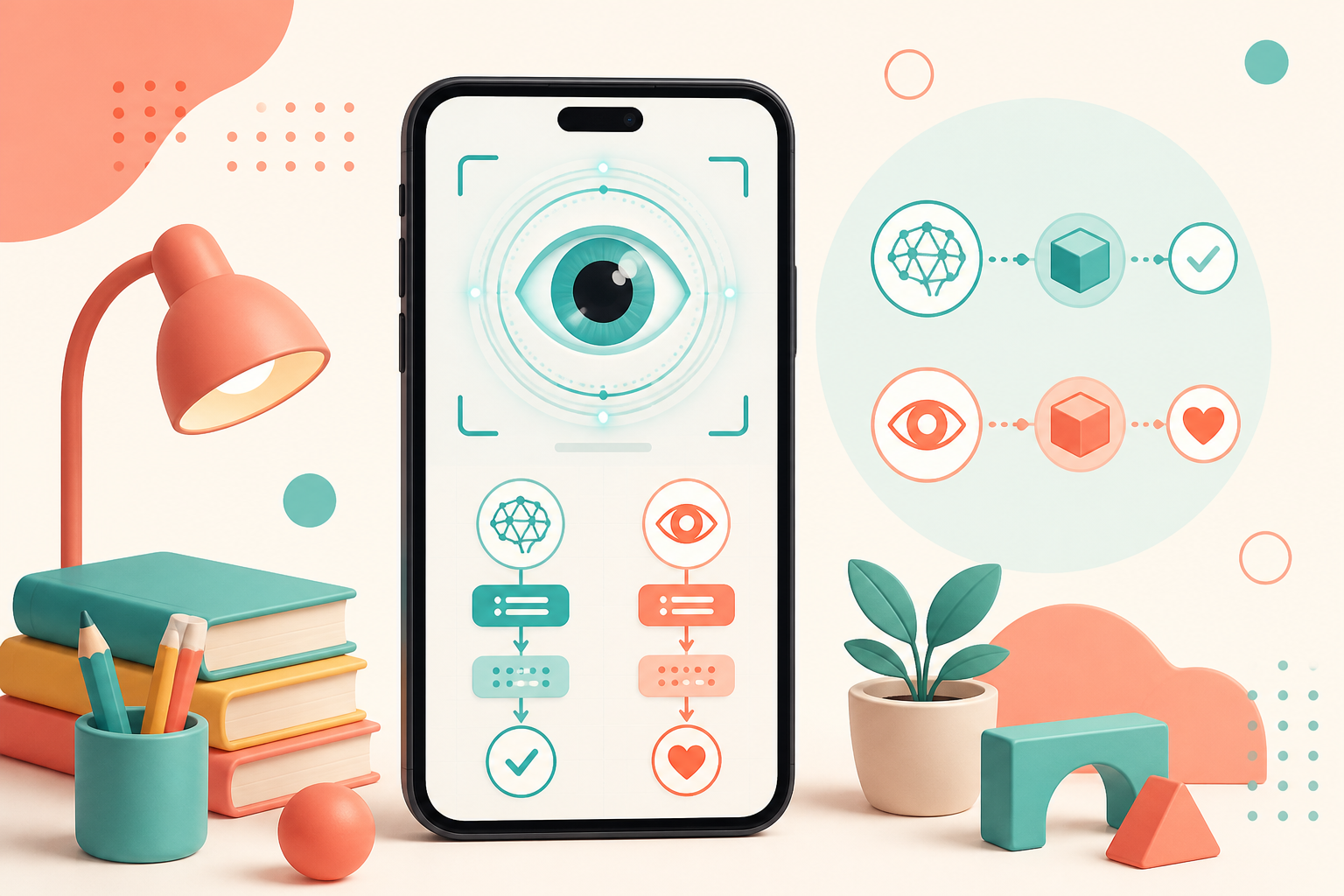
Phone camera → dual AI pipelines — illustration for this case study
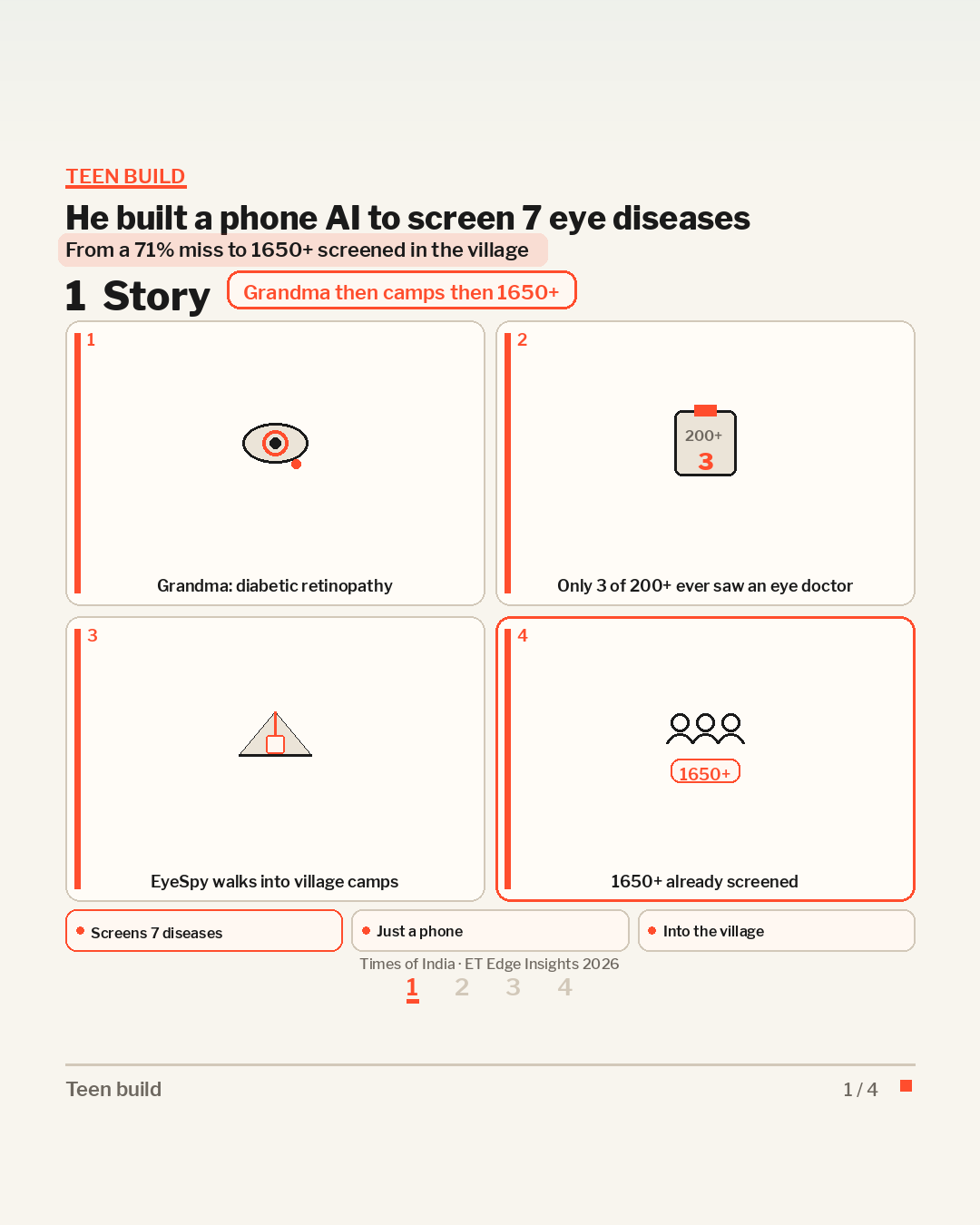
Siddhartha Manaktala’s grandmother lived with diabetic retinopathy for years. He and his dad both wear strong corrective prescriptions. At 17, still in Class XII in Gurugram, he surveyed more than 200 low-income and elderly neighbours — only three had ever seen an ophthalmologist. He built EyeSpy, an AI smartphone platform that screens for seven eye diseases, then took it into community eye camps. Reporting: Times of India / ET Edge Insights (2026).
Why this matters
AI here turns a phone photo into a disease-class decision fast enough for a village camp — then he rebuilt until specialists could trust it in the field.
How AI actually helped (facts only)
|
71%→90.1% camp accuracy |
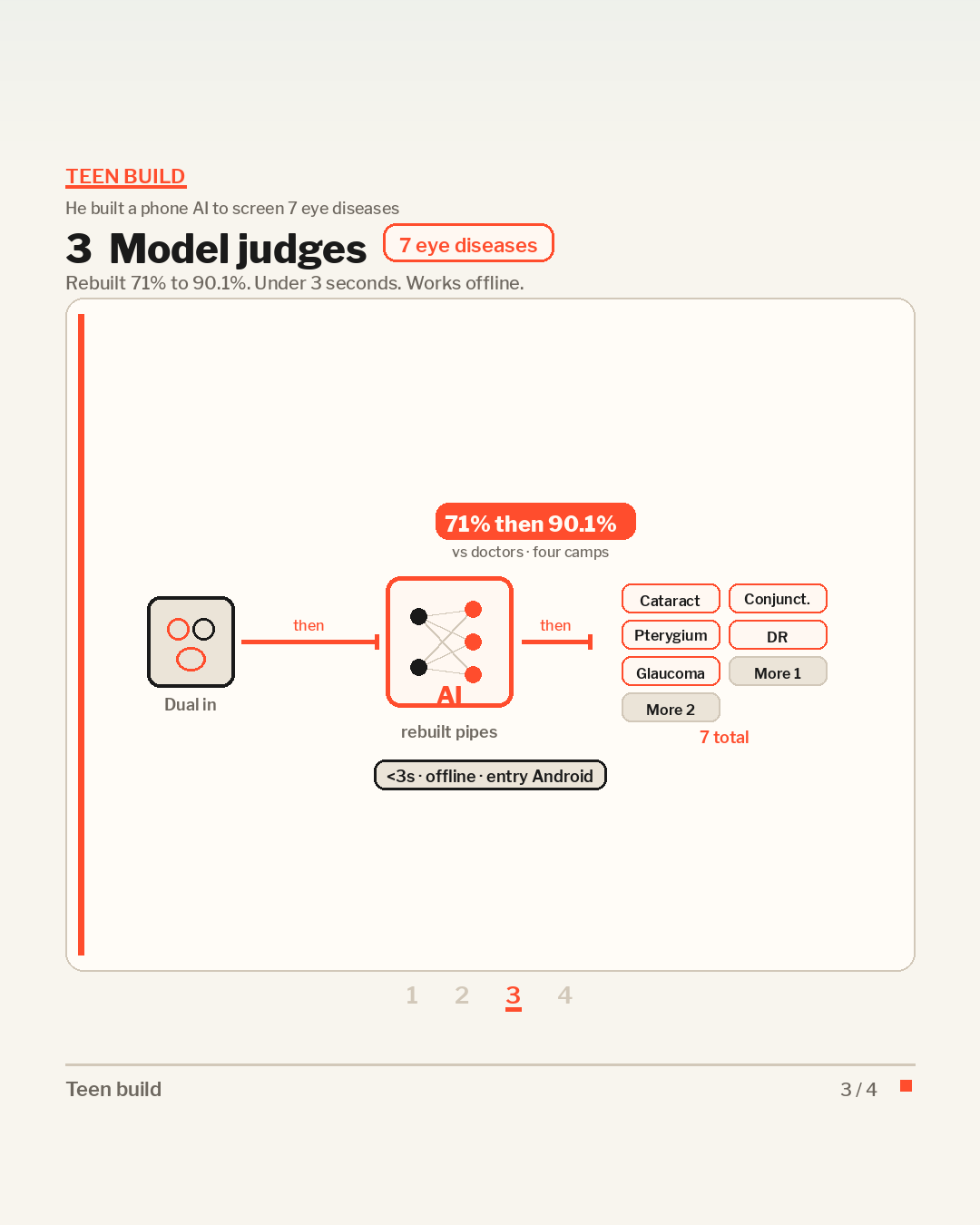
<3 s offline Android |
1,650+ people screened |
7 eye diseases |
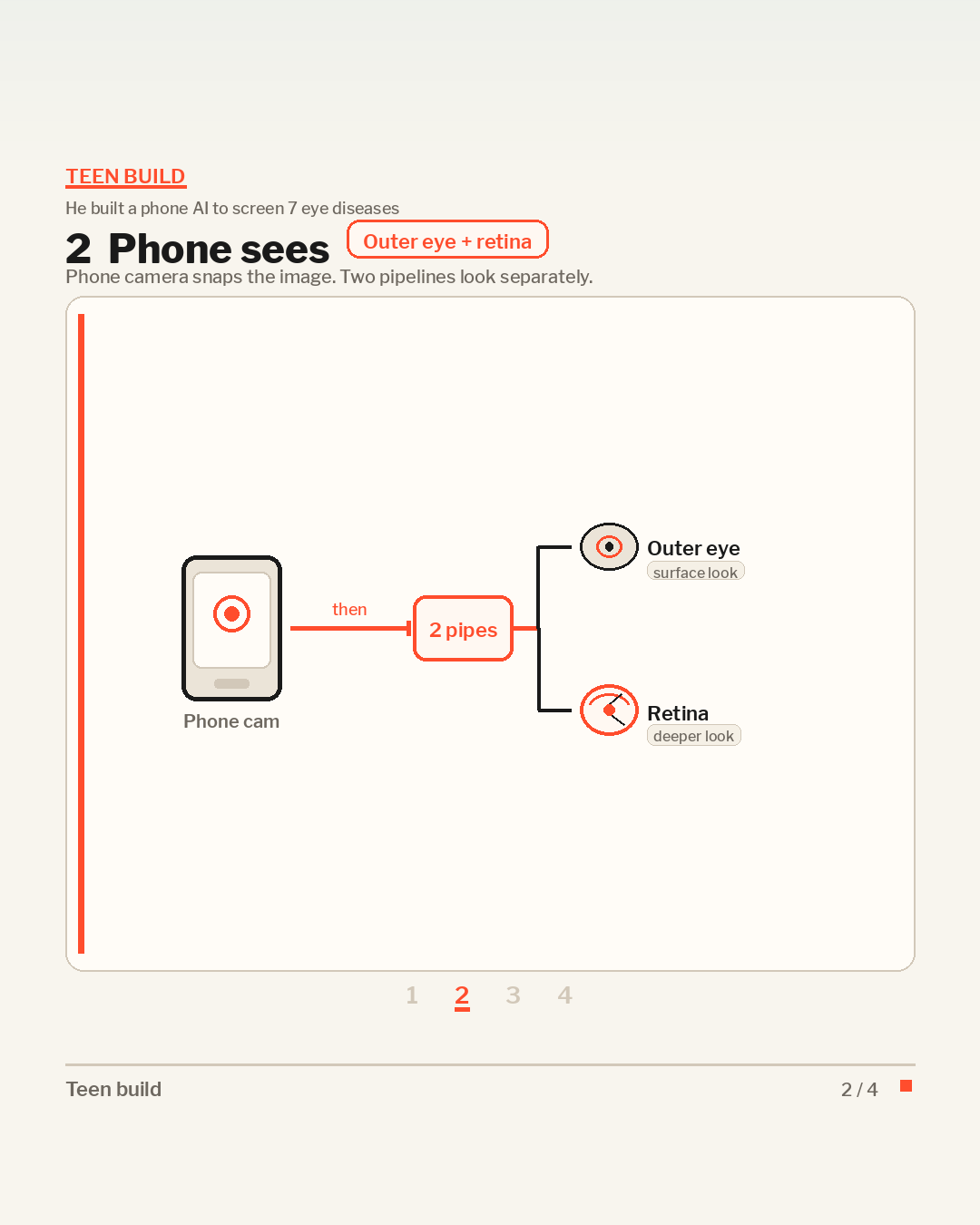
- Seeing the eye from a phone. Two AI pipelines — outer eye + retina. Optional ~Rs 1,200 lens. Entry-level Android, under three seconds, can run offline.
- Classifying seven diseases. Cataracts, conjunctivitis, pterygium, diabetic retinopathy, glaucoma, and more. First camp model hit 71%; a week at L V Prasad Eye Institute rebuilt the dual pipelines.
- Getting screening to people who miss clinics. Haryana camps: 99% never had an eye exam; >25% undiagnosed disease; >35% did not know they had a vision problem. Four camps reached 90.1% vs attending ophthalmologists. Crowdfunded Rs 1 lakh for field kits. Asha, 12, thought she was bad at school — she needed glasses.
Also on the record: silver at IRIS and INSEF; mentorship from LVPEI and Lenskart.
Three steps kids can name
We do not copy a week inside an eye institute. We practice the same shape:
1 · See — phone camera as a sensor
2 · Judge — which of seven labels?
3 · Mission — capture → classify → kit or referral
see with a sensor → judge with a rule → run a mission
Phone camera → classify seven diseases → village camp. Computational thinking kids can own.
- Decomposition — see → decide → finish the mission
- Abstraction — image in, label out, with a measurable accuracy score
- Algorithms — including the offline path when the network is gone
- Pattern recognition — rebuild when 71% is not good enough (90.1% is published outcome, not a classroom guarantee)
Try this at CodeSky Markham
Walk-in coding afterschool for ages 7–18. Sensor → rule → mission is what we practice on the bench.
9833 Markham Rd Unit 2, Markham, ON L6E 0E5
Email info@codesky.ca · Comment TRIAL on Instagram @codeskyca
Follow CodeSky
Instagram @codeskyca · RedNote · WeChat: search codeskyca
Sources
Times of India / ET Edge Insights (2026), coverage of Siddhartha Manaktala and EyeSpy (dual AI pipelines, seven diseases, 71% → 90.1%, <3s offline Android, Haryana camps, 1,650+ screened, Asha, Rs 1 lakh kits, IRIS/INSEF silver, LVPEI + Lenskart).