





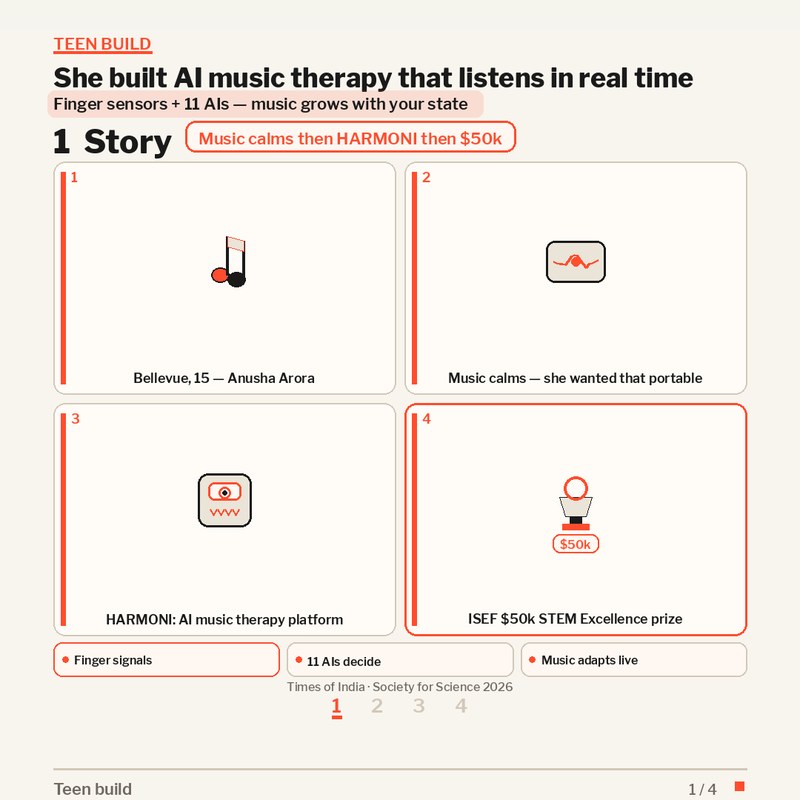
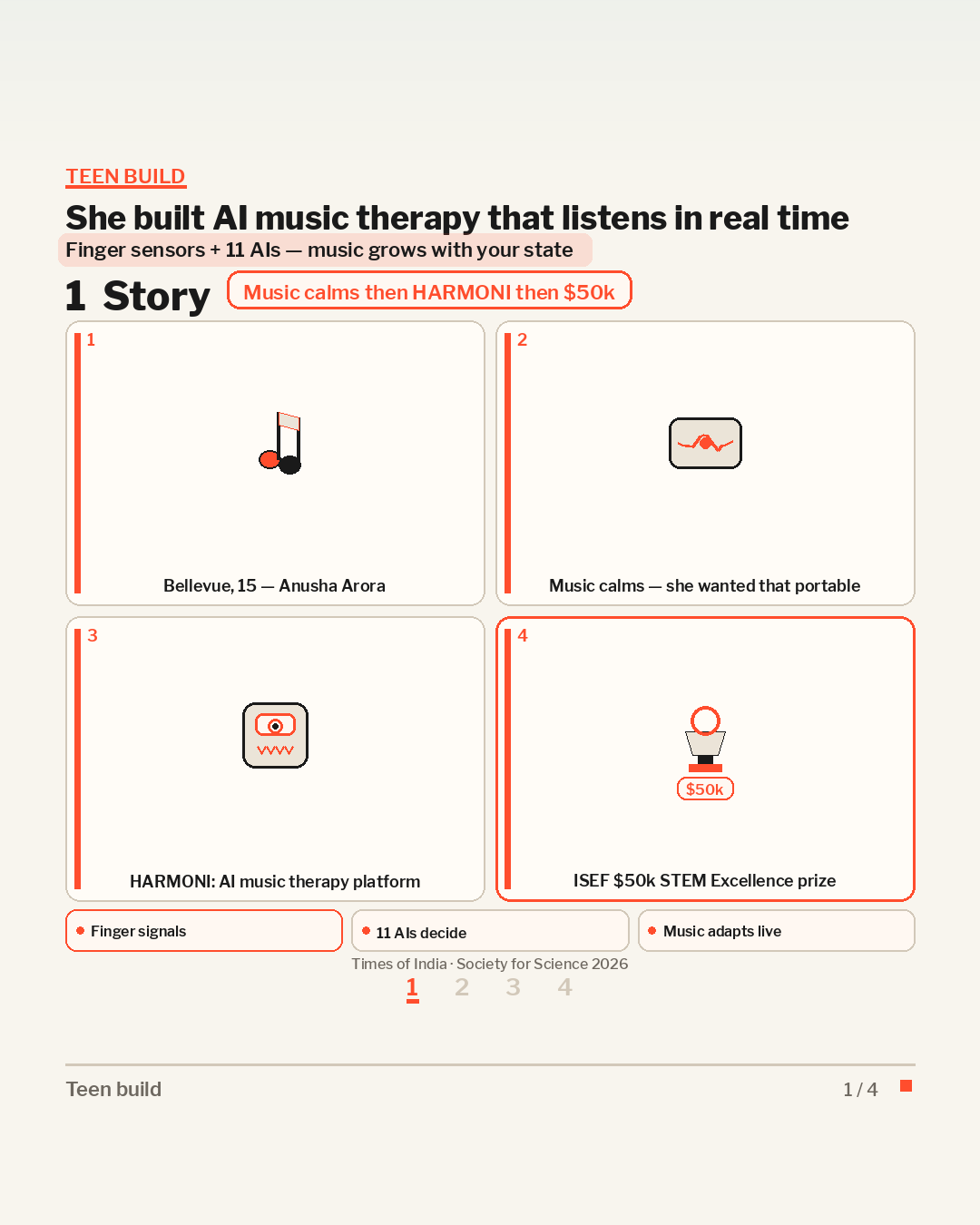
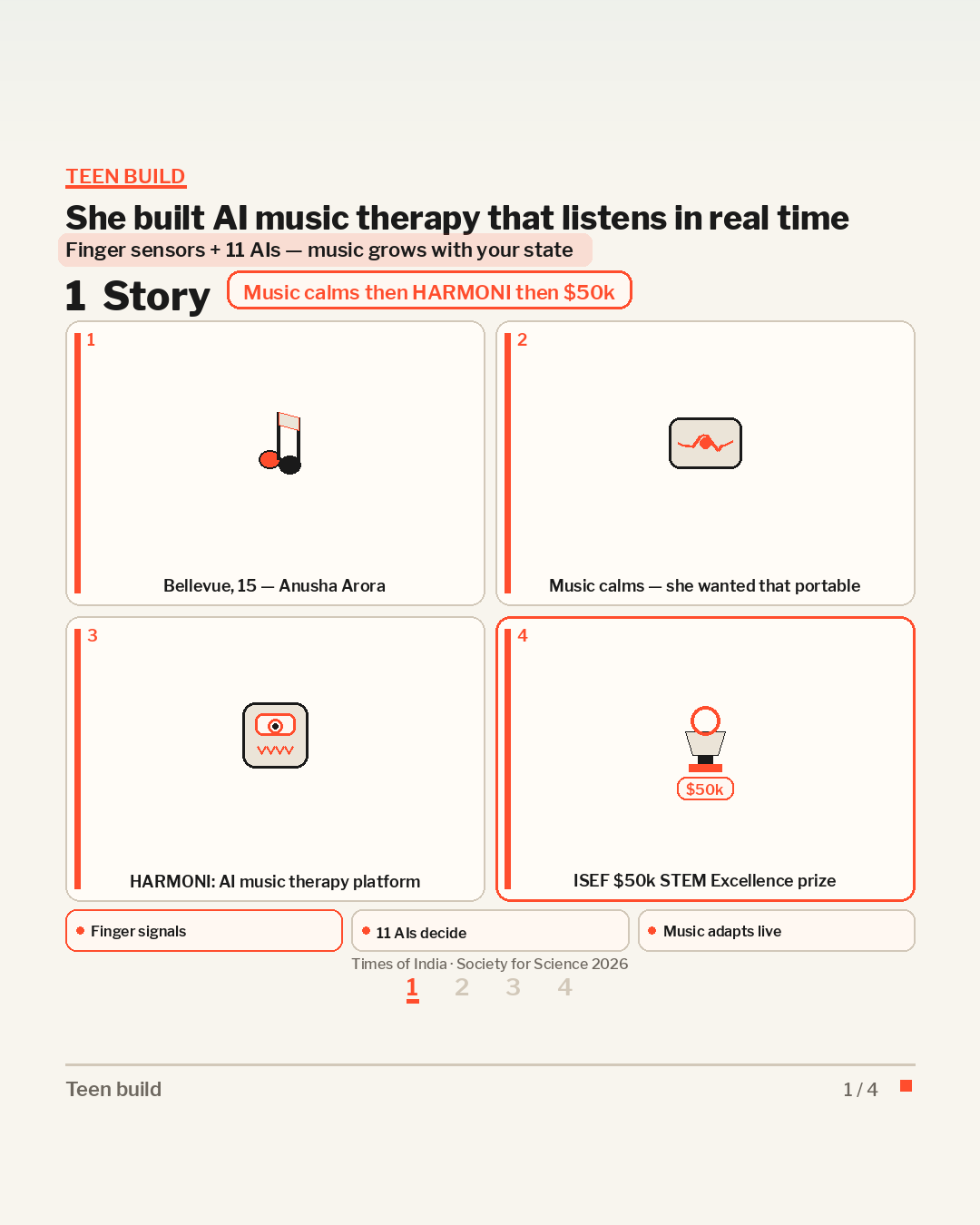
Finger sensors → 11 AIs → real-time music — English carousel cover for this case study
Anusha Arora was 15, at Interlake High School in Bellevue, Washington, when she noticed something small and stubborn: when her mother listened to music, stress eased. Most people would leave that observation alone. She asked whether a machine could see that calm arrive — then carry the therapy with you. She built HARMONI (some reporting also says Harmony), an AI-powered music therapy platform. Reporting: Times of India; Society for Science / Regeneron ISEF 2026.
Why this matters
AI here turns fingertip physiological signals into an emotion-state decision, then generates music and visuals on the fly — not a fixed playlist.
How AI actually helped (facts only)
|
11 AI programs |
Finger sensors |
$50k ISEF prize |
Real-time music + visuals |
- Seeing the body from the fingertips. Finger sensors gather physiological data so emotional state does not have to be spoken first.
- Judging with eleven AI programs together. Eleven AI programs detect emotional state together — not one model alone — then drive what happens next.
- Running a real-time mission instead of a fixed playlist. Generates music and visuals in real time as state changes; portable. Experiments: reductions in stress and anxiety; participants stayed more engaged. Targets cost, provider shortages, and insurance gaps for music therapy.
On the record at Regeneron ISEF 2026: inaugural F. Thomson Leighton and Bonnie Berger Family Prize for STEM Excellence — $50,000 scholarship (Society for Science; Times of India). HARMONI remains a research project, not a replacement for professional mental health care.
Three steps kids can name
We do not ask kids to ship a clinical therapy product. We practice the same shape:
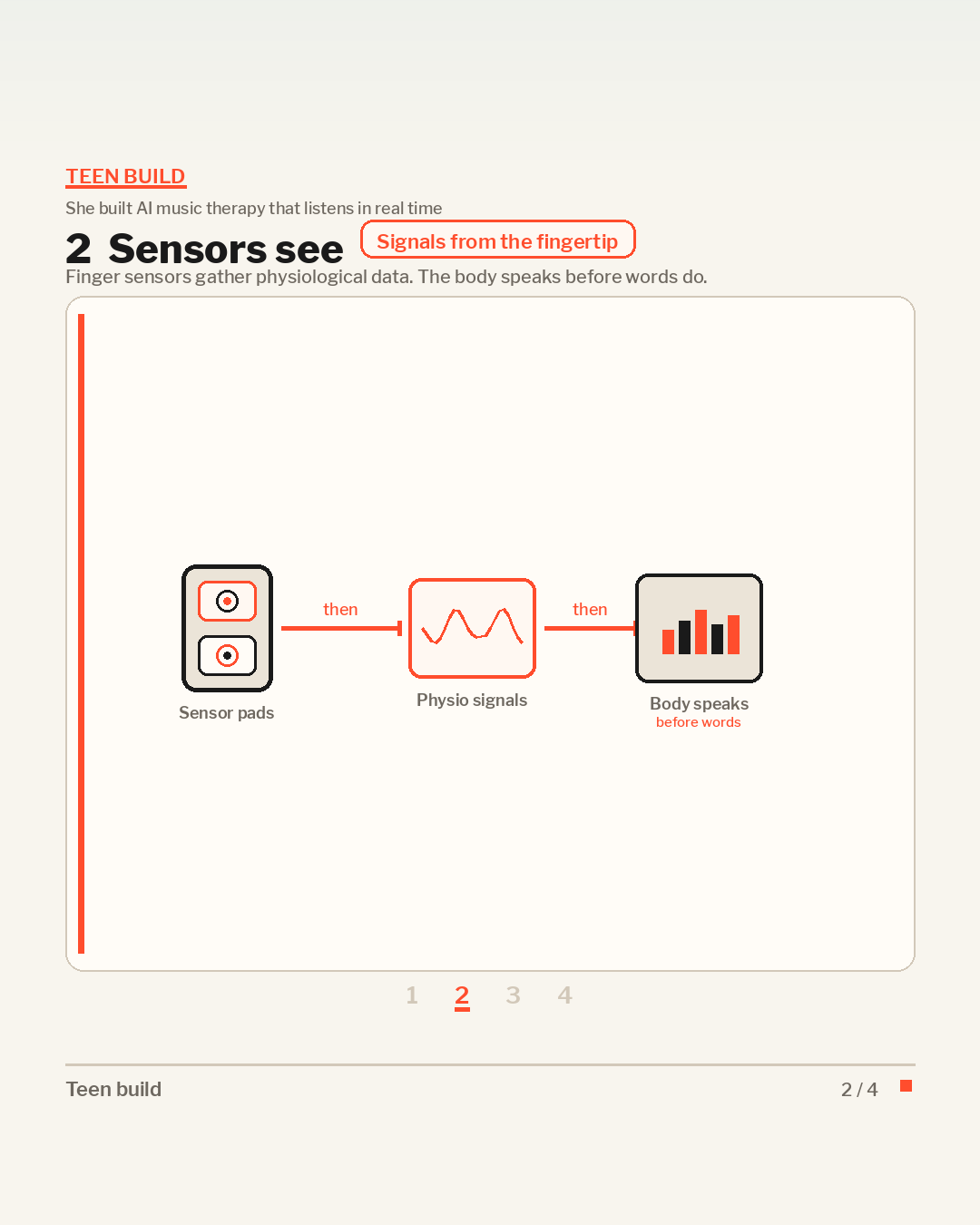
1 · See — finger sensors as physiological input
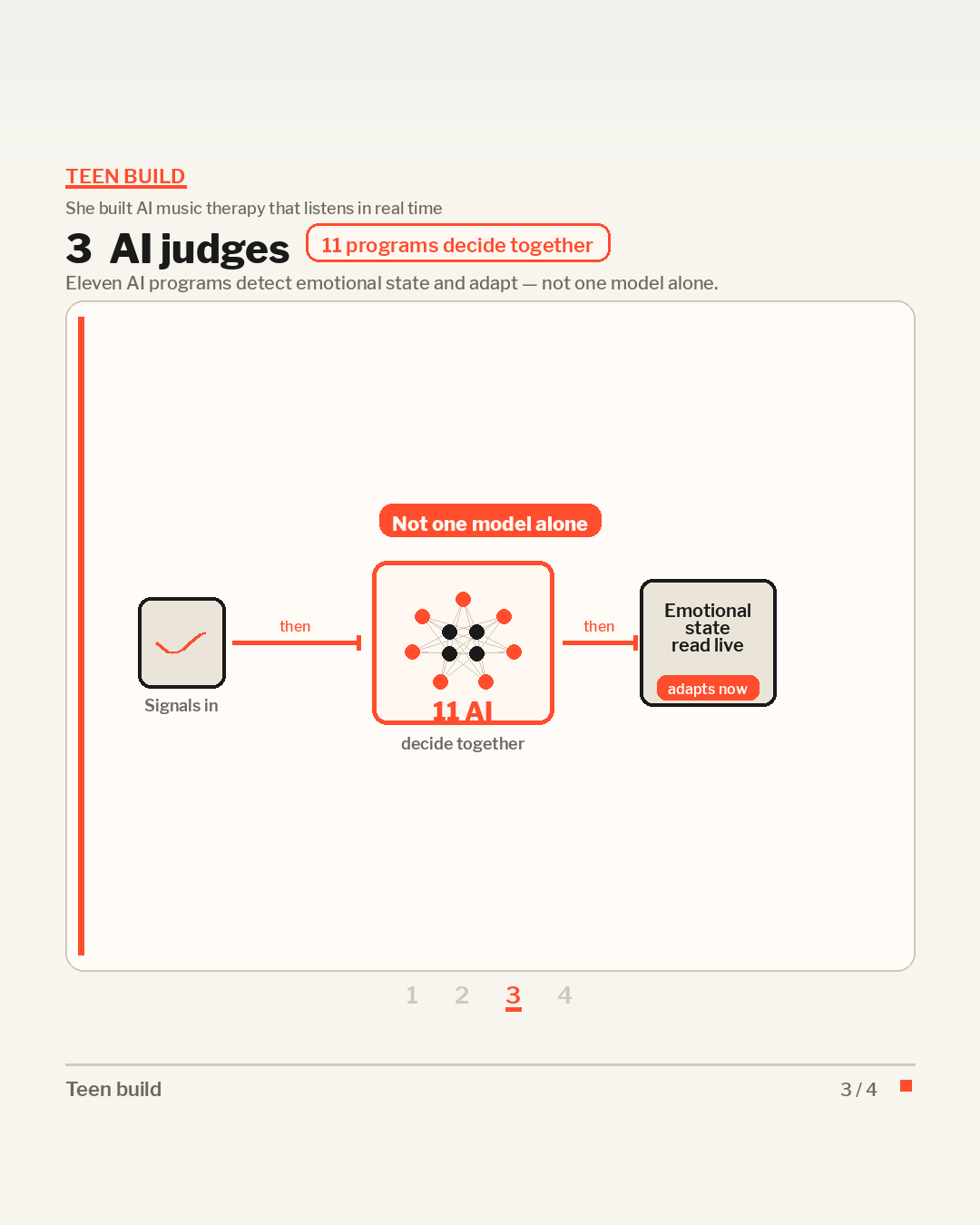
2 · Judge — 11 AIs decide emotional state
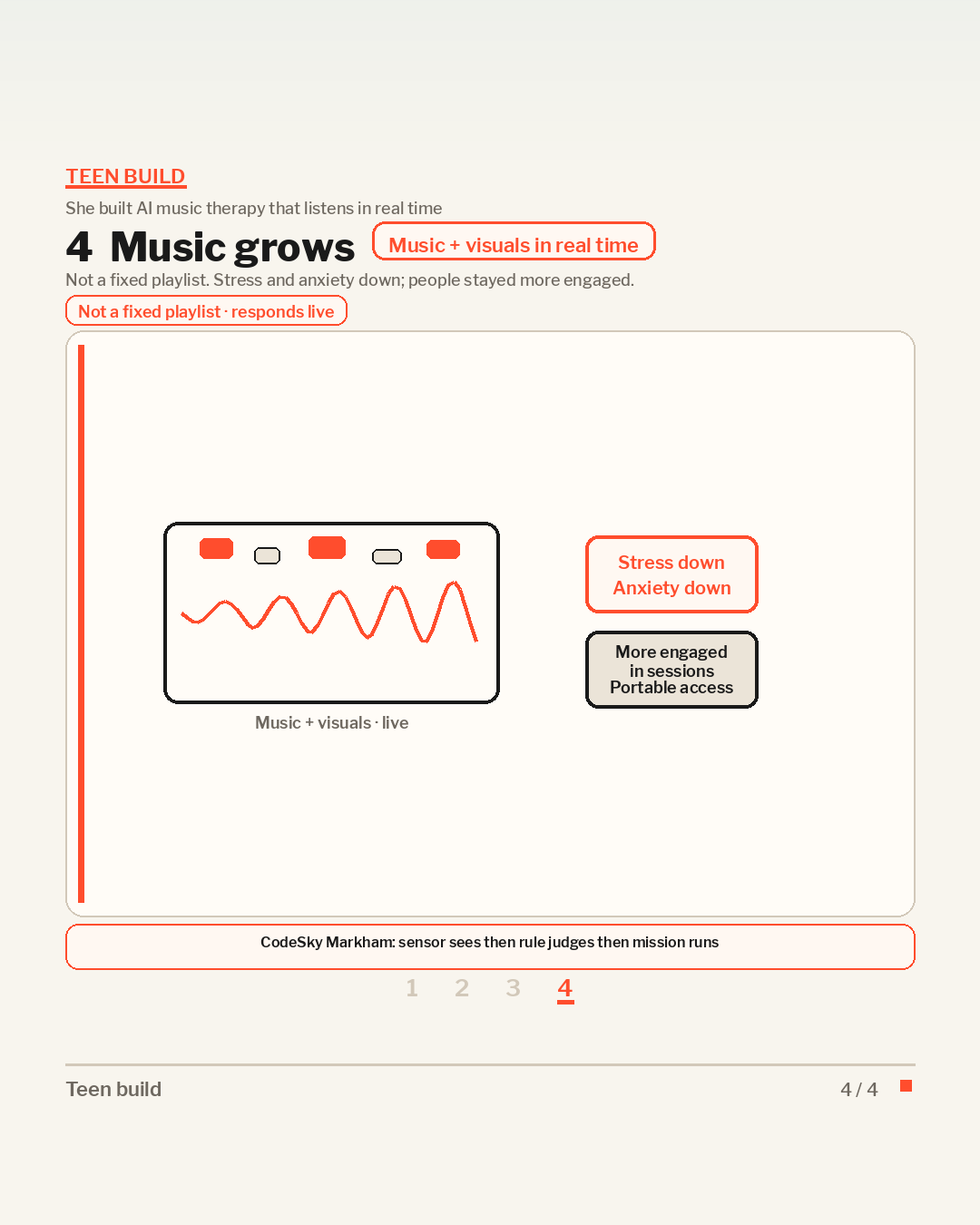
3 · Mission — generate music + visuals in real time
see with a sensor → judge with a rule → run a mission
Finger sensors → 11 AIs → real-time music + visuals. Computational thinking kids can own.
- Decomposition — see → decide → finish the mission
- Abstraction — physiological signals in, emotion-state out — not magic empathy
- Algorithms — sense → classify → generate, updating as state changes
- Pattern recognition — a fixed playlist is a different algorithm from real-time generation that follows the body
Try this at CodeSky Markham
Walk-in coding afterschool for ages 7–18. Sensor → rule → mission is what we practice on the bench.
9833 Markham Rd Unit 2, Markham, ON L6E 0E5
Email info@codesky.ca · Comment TRIAL on Instagram @codeskyca
Follow CodeSky
Instagram @codeskyca · 小红书 / RedNote · WeChat 公众号: search codeskyca
Sources
Times of India (2026); Society for Science / Regeneron ISEF 2026 grand awards (TECA008), coverage of Anusha Arora and HARMONI (finger sensors, 11 AI programs, real-time music + visuals, stress/anxiety reductions, engagement, $50,000 Leighton–Berger Family Prize).