




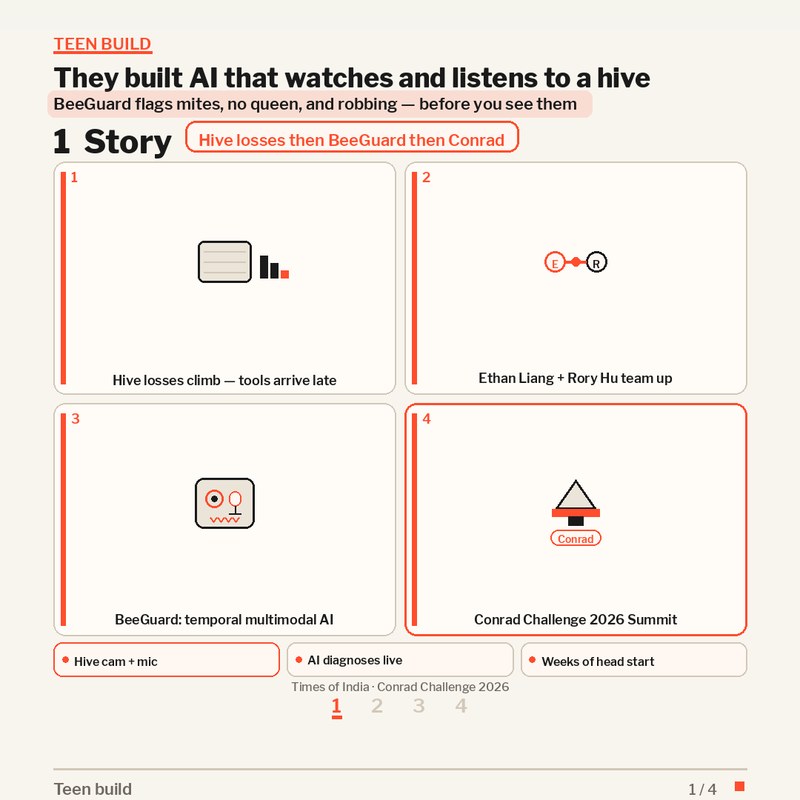
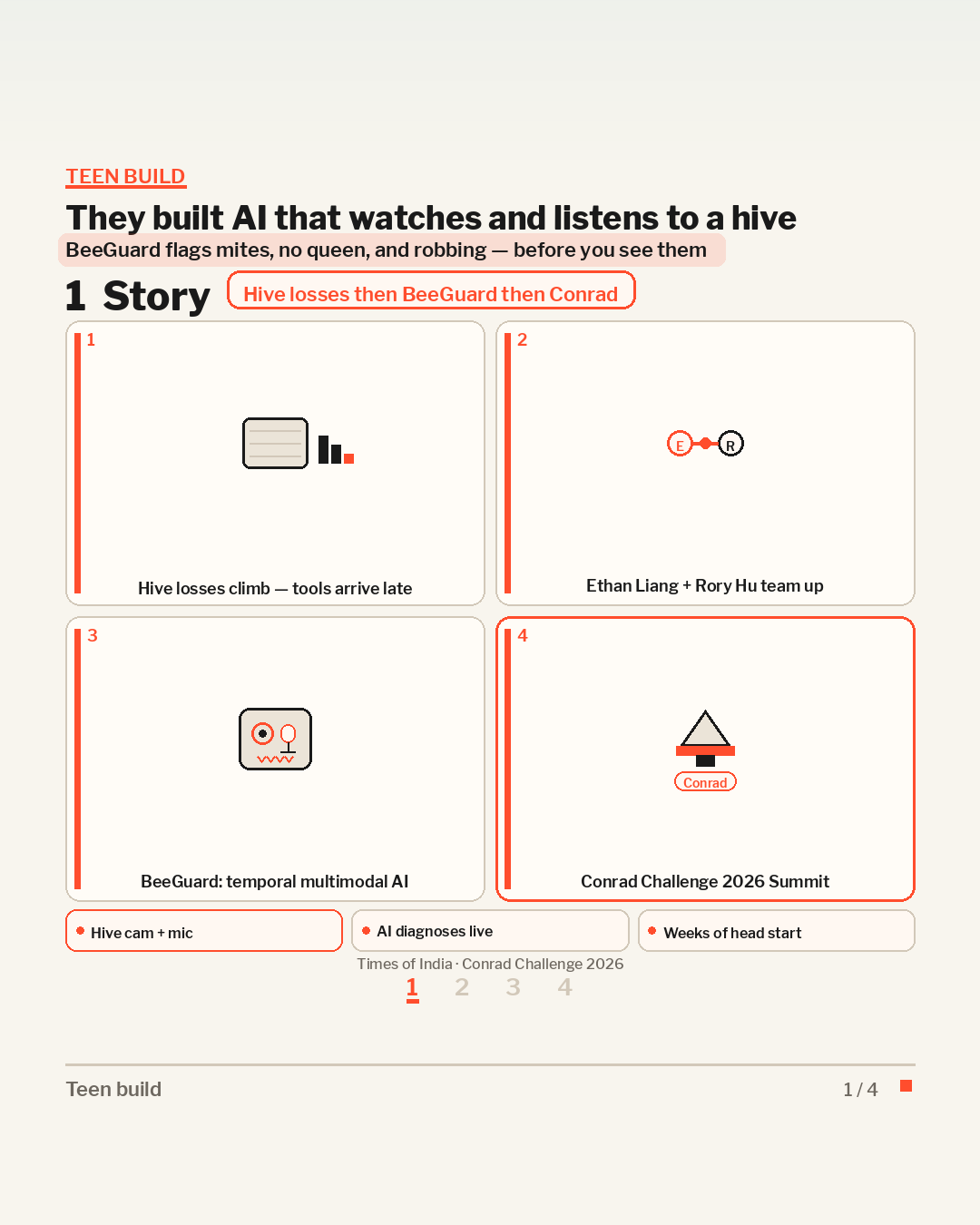
Hive cam + mic → multimodal AI → early colony warning — English carousel cover for this case study
Ethan Liang keeps bees in San Jose, California. Rory Hu researches in Massachusetts. They met through a youth pollinator-advocacy group, then built BeeGuard — an AI web app that reads hive footage and flags colony trouble. Reporting: Times of India; Conrad Challenge 2026.
Why this matters
AI here turns vision + sound + behaviour into an early diagnosis — not another spreadsheet of hive vitals.
How AI actually helped (facts only)
|
94.7% accuracy <1s |
3 signals: vision · sound · behaviour |
4 colonies field-validated |
Weeks before visible symptoms |
- Seeing the hive from footage they already had. Computer vision, acoustic analysis, and behavioural tracking run on hive cam/mic footage — no additional hardware. Commercial hive monitors often start around $300+ and mostly log temperature or weight without diagnosing what is wrong.
- Judging with multimodal AI in under a second. Flags varroa mites, queenlessness, and hive robbing at 94.7% accuracy in under 1 second. Coverage calls it the first temporal multimodal AI diagnostic for beehive health.
- Running an early-warning mission that changes the outcome. Field validation across 4 colonies flagged problems weeks before visible symptoms. Interventions that followed the alerts had 100% success. Same reporting: bees pollinate about one-third of crops; roughly 40% colony loss/year; U.S. losses around $15B.
They presented at the 2026 Conrad Challenge Innovation Summit on the Pete Conrad Scholars path (coach Yanin Wu). Sources: Times of India; Conrad Challenge 2026.
Three steps kids can name
We do not ask kids to ship a commercial hive product. We practice the same shape:
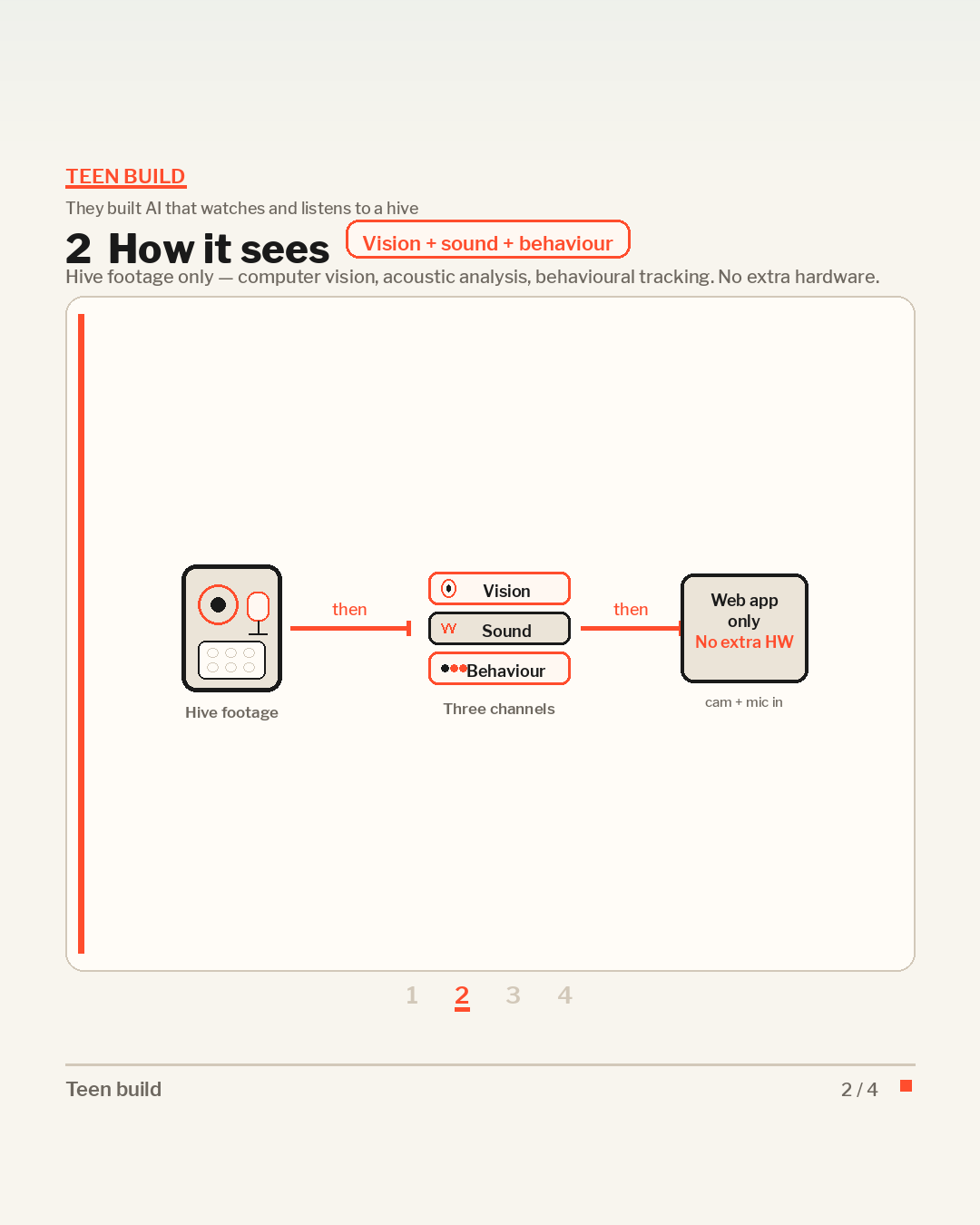
1 · See — hive cam + mic as multimodal input
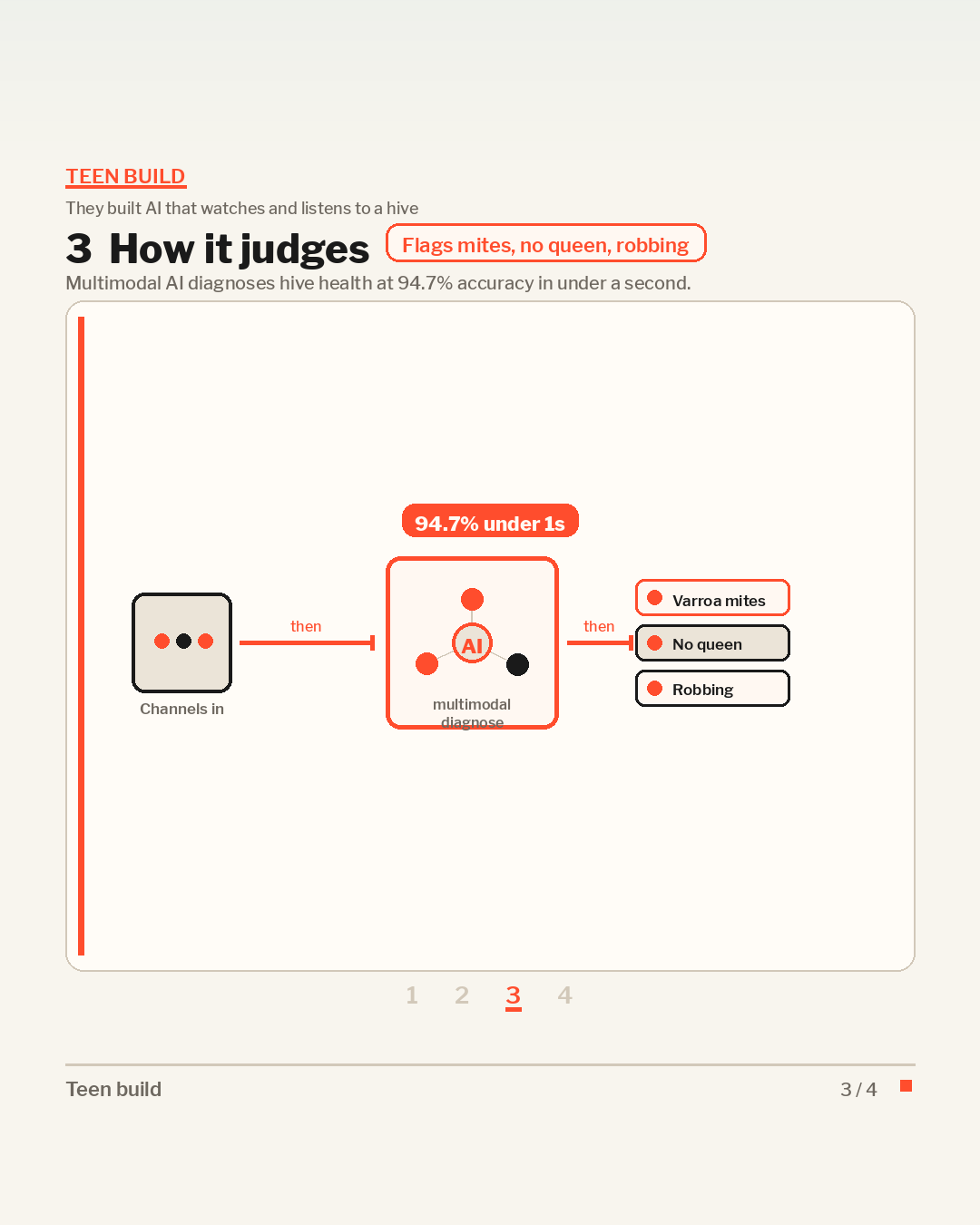
2 · Judge — multimodal AI flags mites / no queen / robbing
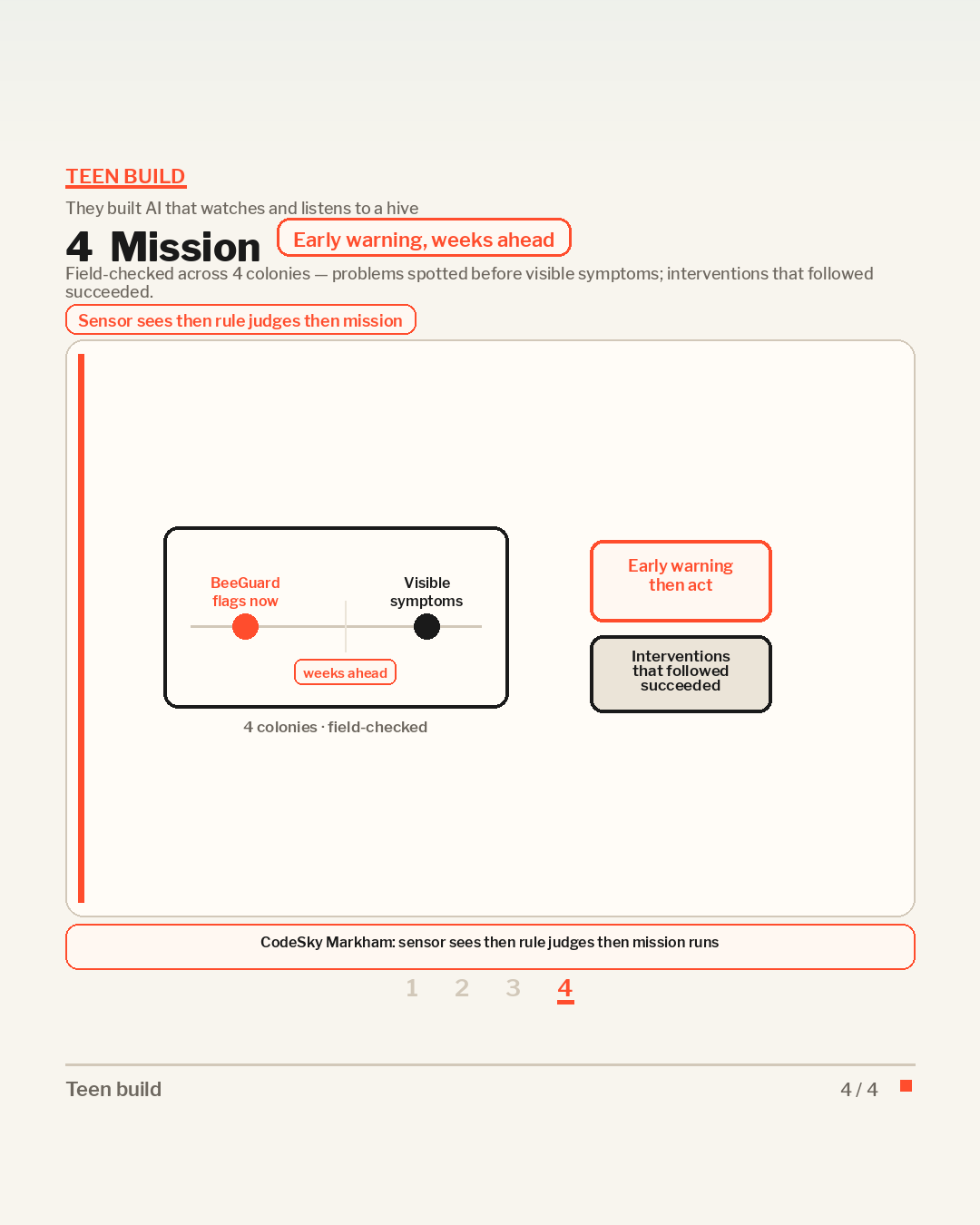
3 · Mission — early warning weeks ahead so interventions can work
see with a sensor → judge with a rule → run a mission
Hive cam/mic → multimodal AI → weeks-early warning. Computational thinking kids can own.
- Decomposition — see → decide → finish the mission
- Abstraction — footage in, colony-health out — not magic beekeeper instinct
- Algorithms — sense → classify → warn early enough for an intervention
- Pattern recognition — logging temperature is a different algorithm from diagnosing health from multimodal footage
Try this at CodeSky Markham
Walk-in coding afterschool for ages 7–18. Sensor → rule → mission is what we practice on the bench.
9833 Markham Rd Unit 2, Markham, ON L6E 0E5
Email info@codesky.ca · Comment TRIAL on Instagram @codeskyca
Follow CodeSky
Instagram @codeskyca · 小红书 / RedNote · WeChat 公众号: search codeskyca
Sources
Times of India (2026); Conrad Challenge 2026 — coverage of Ethan Liang, Rory Hu, and BeeGuard (computer vision + acoustic analysis + behavioural tracking; 94.7% accuracy under 1s; no additional hardware; 4-colony field validation; weeks-early warnings; 100% success on followed interventions; ~1/3 crops pollinated; ~40% colony loss/year; ~$15B U.S. losses; commercial monitors $300+).