




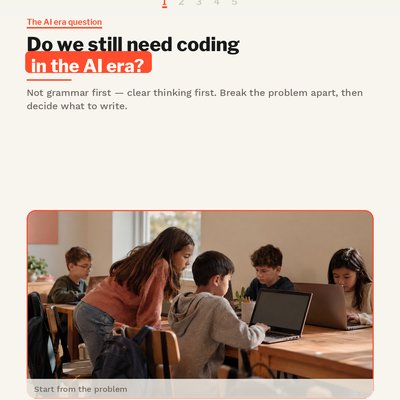
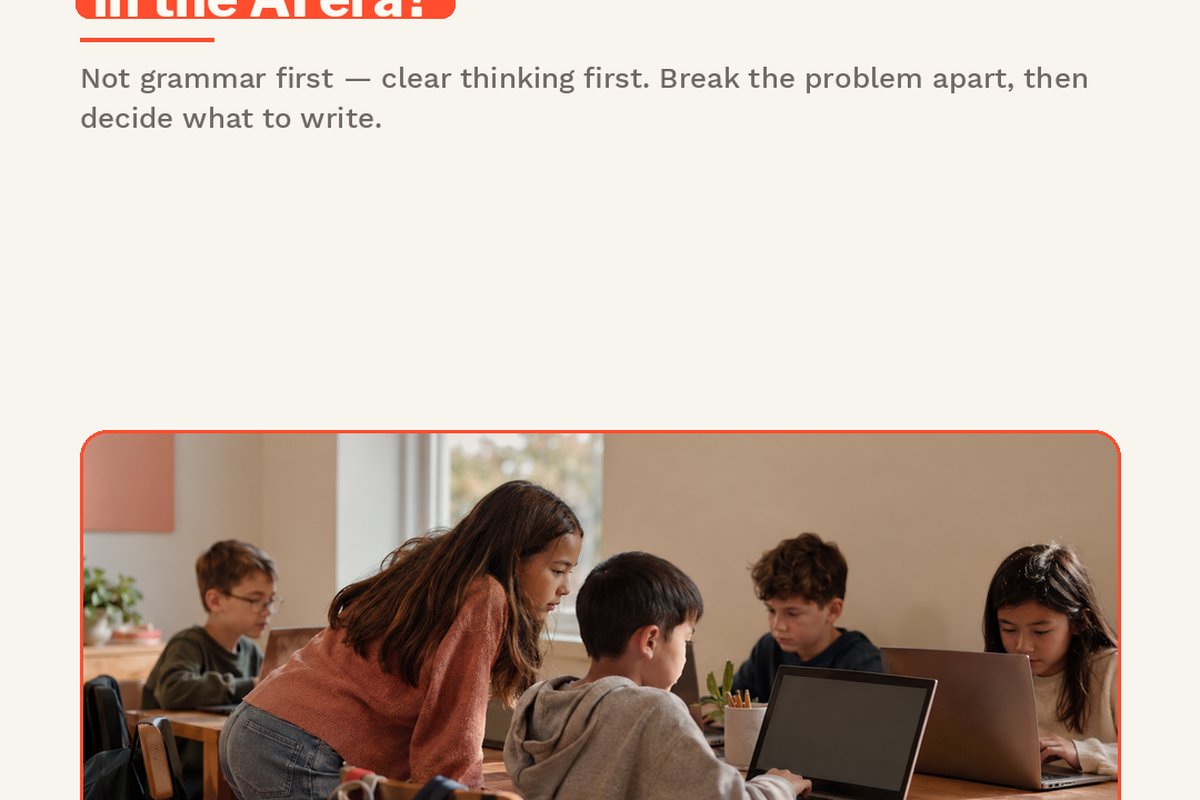
Think first, then build — English carousel cover for this classroom case
Parents often ask which language a kid should start with — Python, JavaScript, or C++. In our Markham classroom we watch for something else first: when a problem shows up, does the kid stop and think it through before touching the keyboard?
Why this matters
AI can type code. It cannot replace a kid who can name the real goal, hold the right state, and check the edge cases.
A real classroom case: find the top two scores
Take a simple list of scores. The job is to name who is 1st and who is 2nd. You do not have to re-sort everyone.
|
Goal top two only — not a full re-sort |
State current 1st · current 2nd |
Update new score vs 1st, else vs 2nd |
Edges ties · highest score last |
That is the whole algorithm. Our 2026-09-12 Xiaohongshu / Instagram note used this exact classroom beat: clear thinking first, grammar second.
Why this still matters when AI can write code
Claims below are grounded in that teaching note — not an external product case with published accuracy metrics.
- AI does not remove the need to name the goal. “Find the top two” is a different problem from “sort the whole list.” If a kid (or an AI prompt) muddles those, the code that comes back solves the wrong job.
- The useful state is tiny on purpose. You only hold current 1st and current 2nd. That is abstraction: keep what the next step needs, drop the rest.
- The update rule repeats. Each new score runs the same check — including ties and a late high score. That repeating update is the algorithm kids can test.
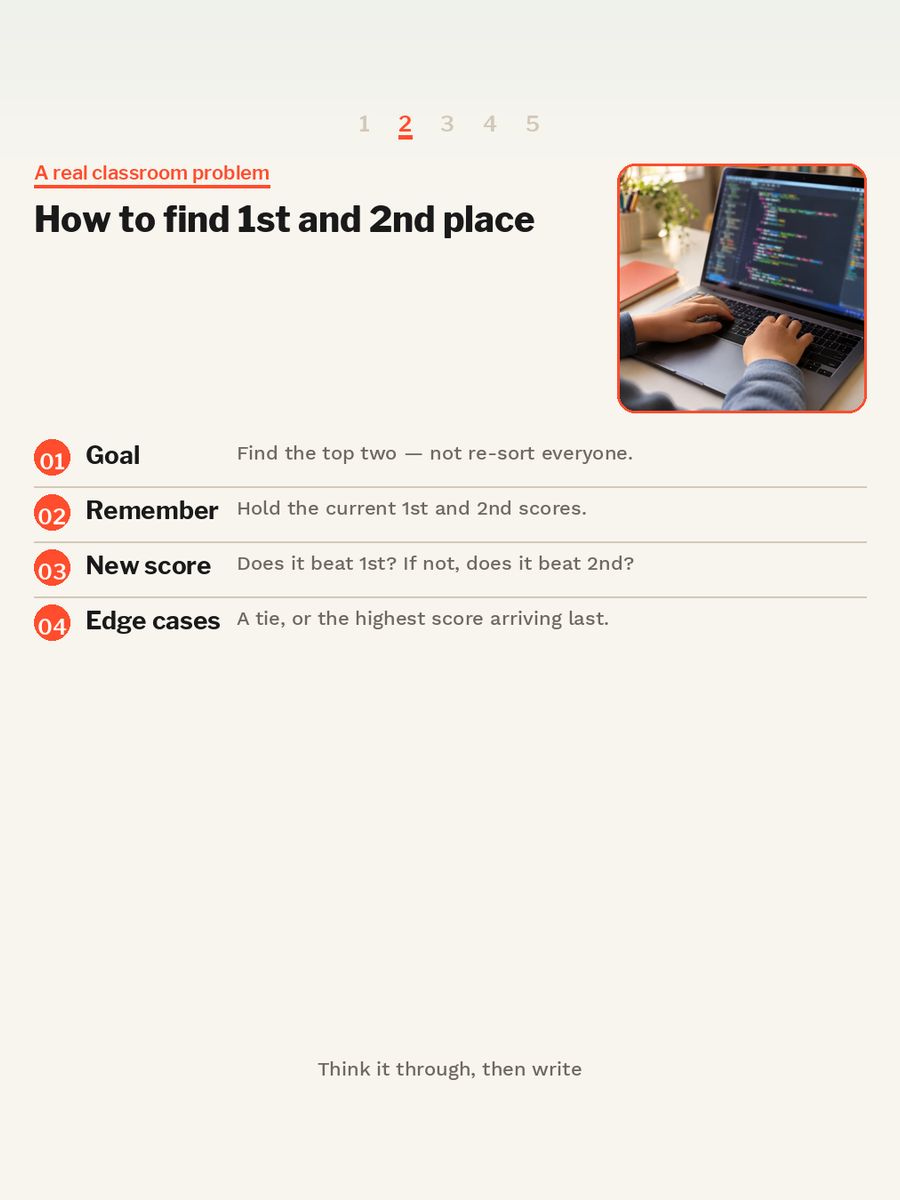
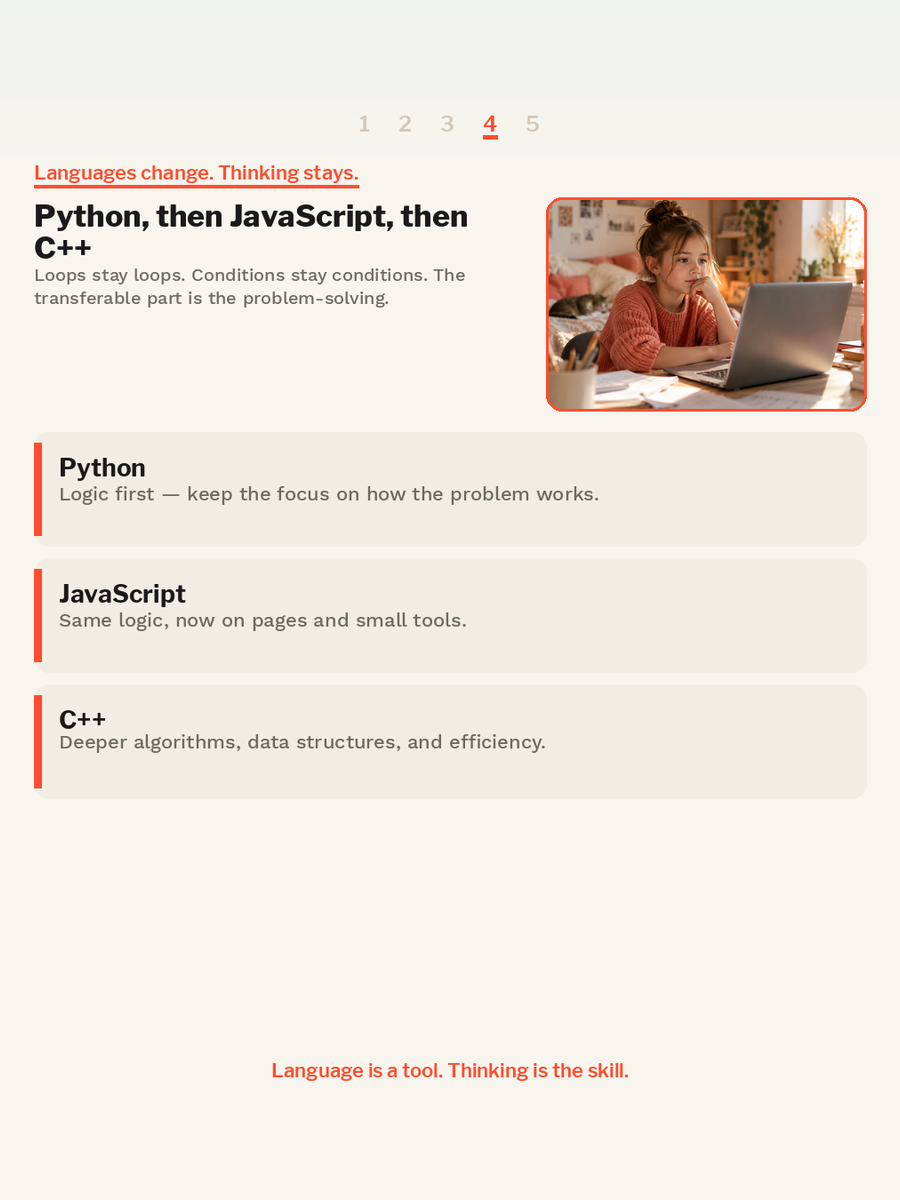
- Languages are tools on a path, not the answer. Early work often uses Python so logic stays visible; JavaScript when the same logic lands in a page or small tool; C++ later for deeper algorithms and efficiency. Contest-style questions inspired by CCC Junior, CCC, BCC, and school contests reuse the same moves — kids who want to sit those register on their own; CodeSky is not an official contest program.
So AI’s presence does not cancel coding class. It raises the value of kids who can decompose, hold the right state, and check the edge cases before they ask a model to type.
Three steps kids can name
We practice the same shape on the bench:
1 · See — read each new score in turn
2 · Judge — update 1st and 2nd with a clear rule
3 · Mission — name the top two correctly, including edges
see the new score → judge with a rule → finish the mission
Computational thinking kids can own — before AI types a line.
- Decomposition — goal → state → update → edge cases
- Abstraction — keep only current 1st and 2nd, not a full re-sort
- Algorithms — compare new score → maybe promote to 1st → else maybe to 2nd
- Pattern recognition — same shape in a maze, score stats, and contest-style input/output
Try this at CodeSky Markham
Walk-in coding afterschool for ages 7–18. Think first, then build — that is what we practice on the bench.
9833 Markham Rd Unit 2, Markham, ON L6E 0E5
Email info@codesky.ca · Comment TRIAL on Instagram @codeskyca
Follow CodeSky
Instagram @codeskyca · 小红书 / RedNote · WeChat 公众号: search codeskyca
Sources: CodeSky Xiaohongshu note pack 2026-09-12-AI时代我们需要学编程吗 and Instagram twin 2026-09-12-still-need-coding-carousel (classroom top-two scores case; Python → JavaScript → C++ pathway; contest-style disclaimer).
