




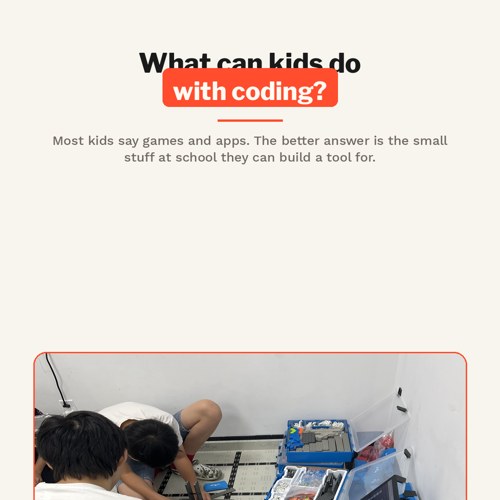
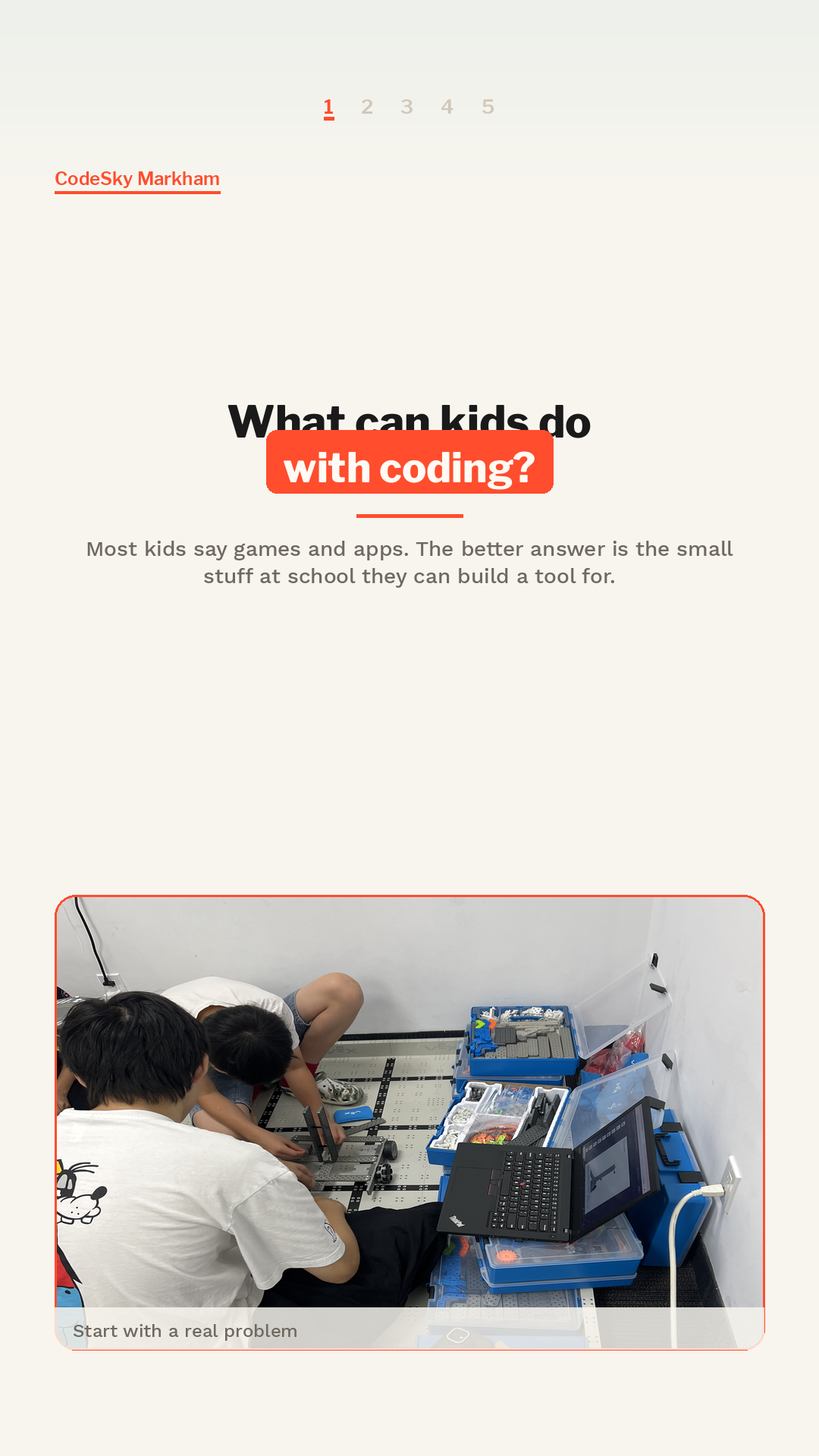
Think the problem first — English carousel cover for this classroom case
Parents often hear “games and apps” when a kid answers what coding is for. In our Markham classroom we flip that: start with a small everyday school problem, then build a tool that actually helps.
Why this matters
AI can type code. It cannot replace a kid who can name the goal, hold the right state, and check the edge cases.
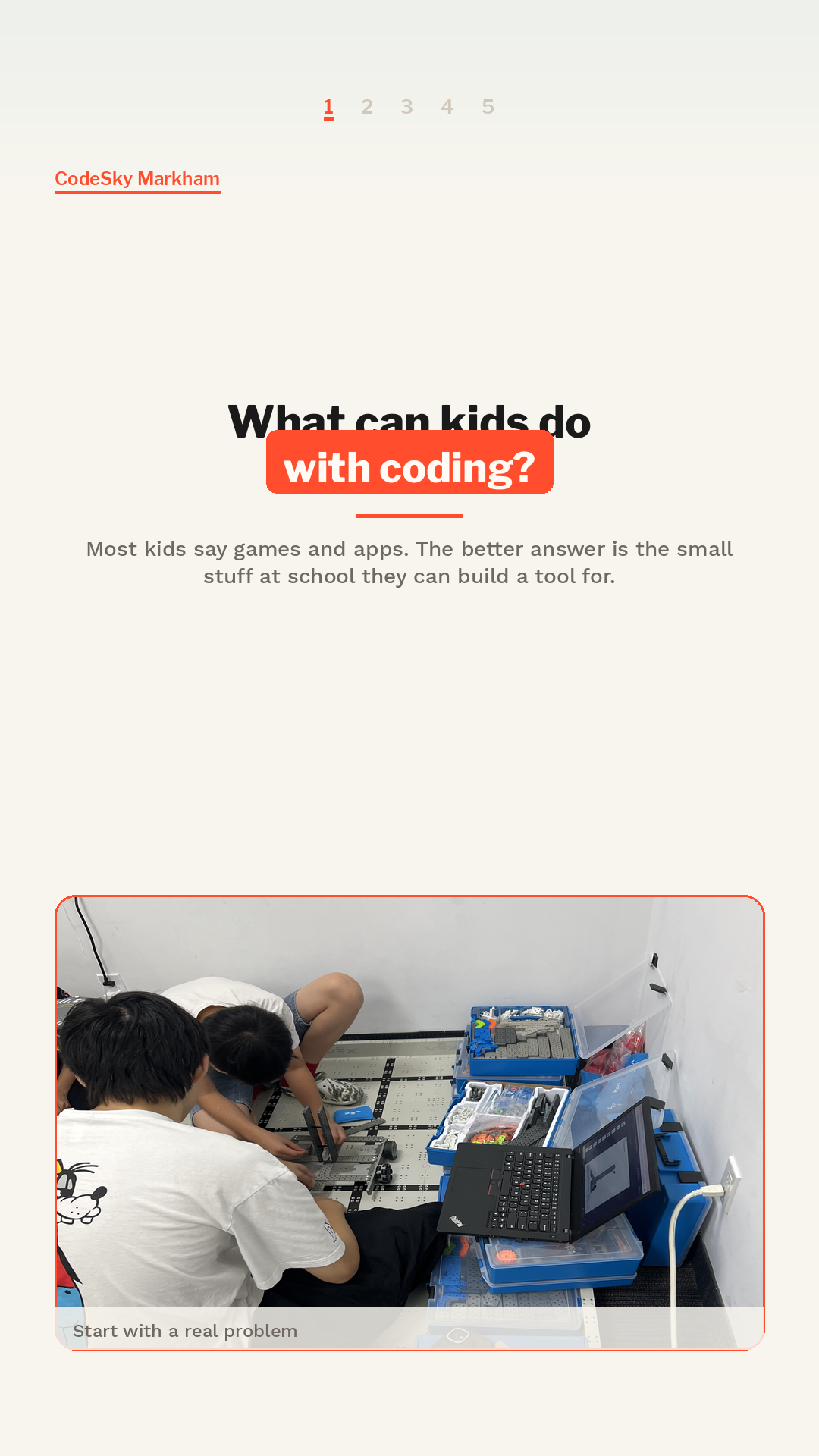
A real classroom case: recess equipment checkout
Last week the case was recess equipment checkout. Soccer balls, jump ropes, badminton rackets — who borrowed what, when it went out, and who is next. Paper plus shouting falls apart the moment the bell rings.
|
Goal checkout without yelling |
State who · what · time out |
Done returned · name cleared |
Edges late · same ball · broken gear |
Once those four answers are clear, the kid has a sketch that can become code. The typing is the fast part. Our 2026-09-14 Xiaohongshu note used this exact classroom beat: clear thinking first, grammar second.
Why this still matters when AI can write code
Claims below are grounded in that teaching note — not an external product case with published accuracy metrics.
- AI does not remove the need to name the goal. “Track who has the ball right now” is a different job from “print a pretty list of sports gear.” If a kid (or an AI prompt) muddles those, the code that comes back solves the wrong problem.
- The useful state is tiny on purpose. You only hold borrower, item, and time out. That is abstraction: keep what the next step needs, drop the rest.
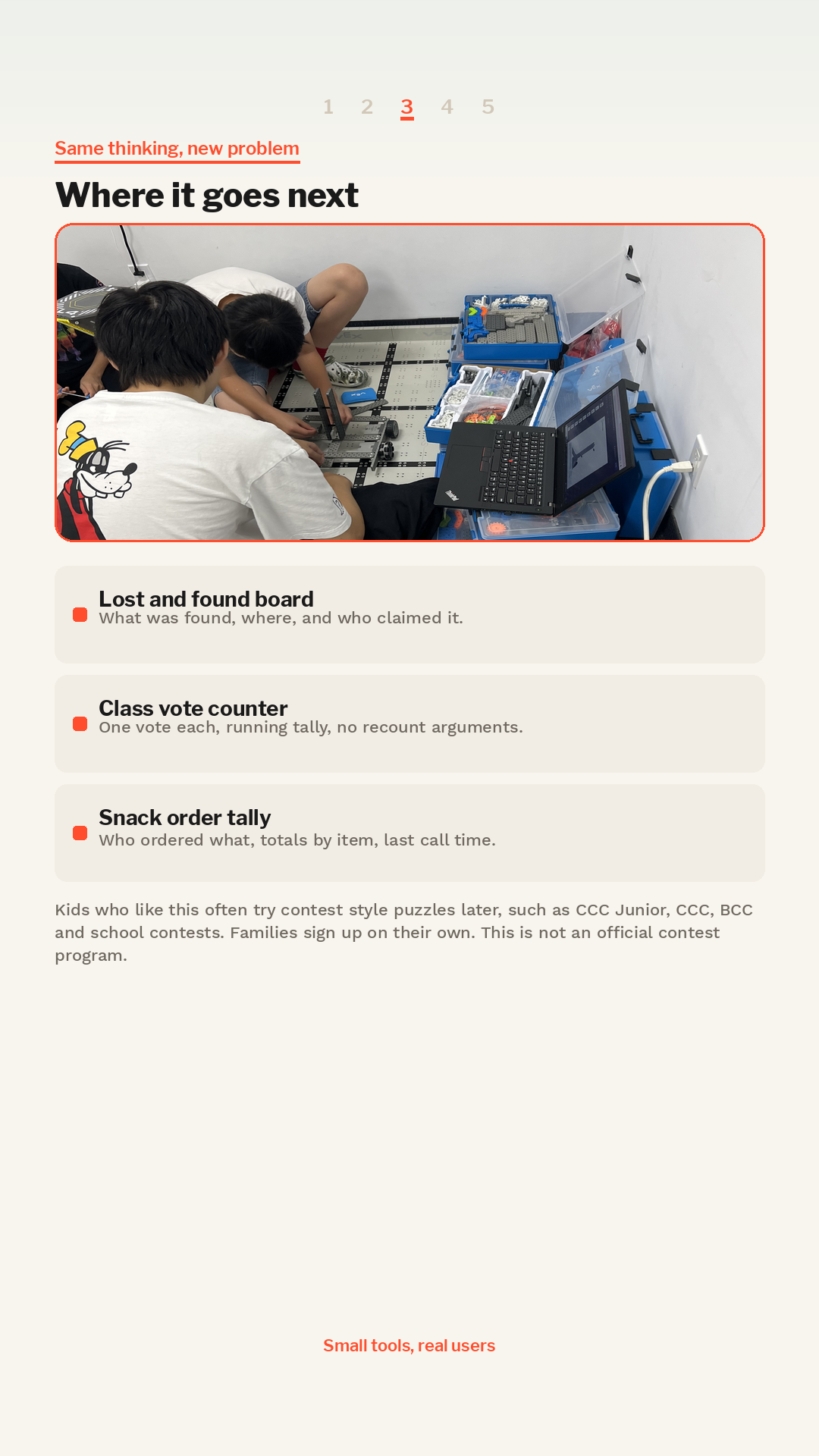
- The done rule and edge cases are the algorithm. The same four questions transfer to a lost-and-found board, a class vote counter, or a snack-order tally. Contest-style questions inspired by CCC Junior, CCC, BCC, and school contests reuse those moves — kids who want to sit those register on their own; CodeSky is not an official contest program.
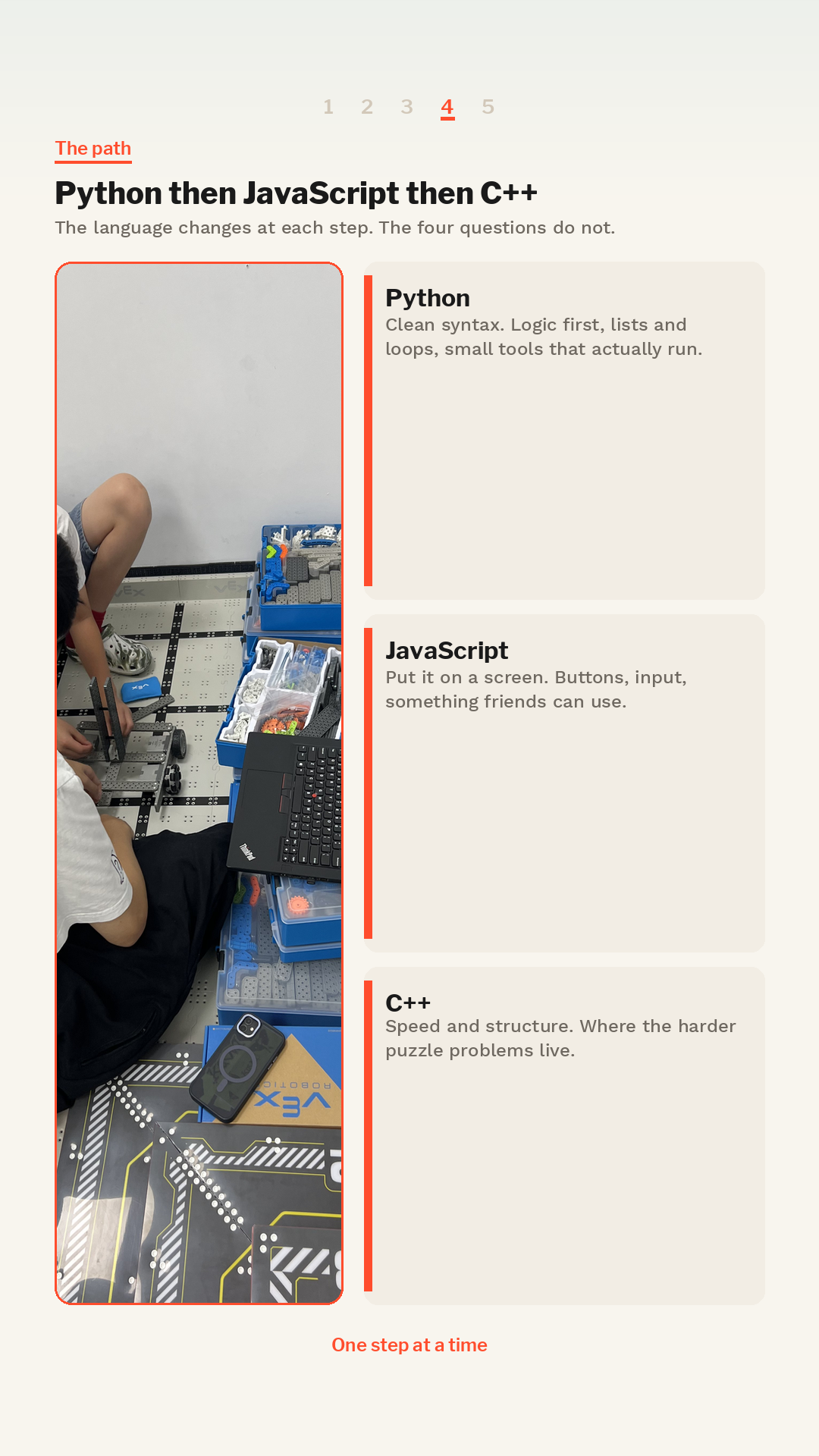
- Languages are tools on a path, not the answer. Early work often uses Python so logic lands fast; JavaScript when the same idea becomes something clickable on a page; C++ later when speed and structure matter. Tools change; the four questions do not.
So AI’s presence does not cancel a thinking-first start. It raises the value of kids who can decompose, hold the right state, and name the edge cases before they ask a model to type.
Three steps kids can name
We practice the same shape on the bench:
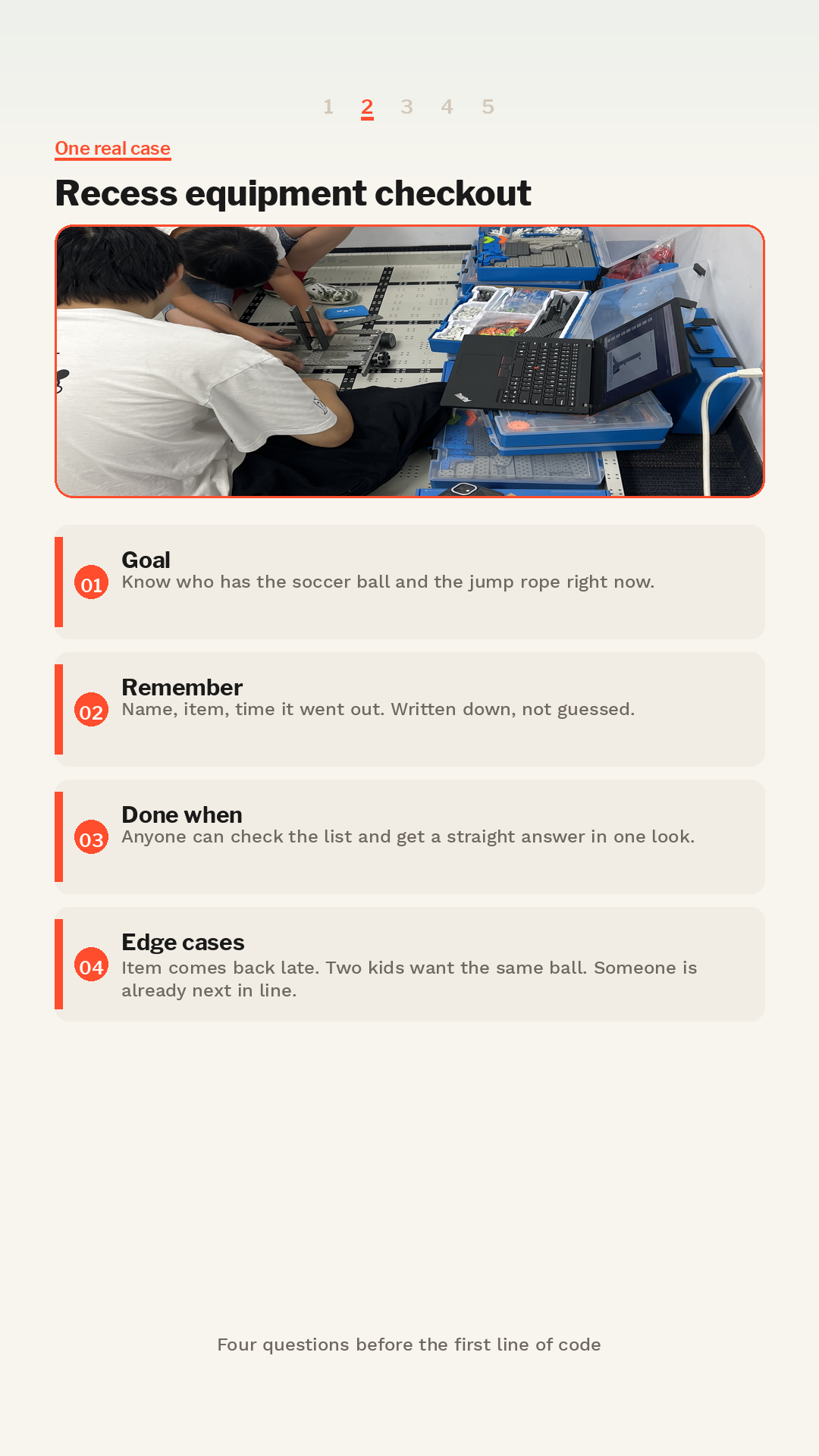
1 · See — who has the gear right now
2 · Judge — apply the done rule and edge cases
3 · Mission — finish checkout so the next kid can borrow
see who has the gear → judge with a done rule → finish the checkout mission
Computational thinking kids can own — before AI types a line.
- Decomposition — goal → state → done rule → special cases
- Abstraction — keep only who, what, and when the next step needs
- Algorithms — borrow → record → return → clear the name
- Pattern recognition — same four questions in lost-and-found, class votes, snack tallies, contest-style I/O
Try this at CodeSky Markham
Walk-in coding afterschool for ages 7–18. Think first, then build — that is what we practice on the bench.
9833 Markham Rd Unit 2, Markham, ON L6E 0E5
Email info@codesky.ca · Comment TRIAL on Instagram @codeskyca
Follow CodeSky
Instagram @codeskyca · 小红书 / RedNote · WeChat 公众号: search codeskyca
Sources: CodeSky Xiaohongshu note pack 2026-09-14-小孩学编程能做什么 (classroom recess equipment checkout case; Python → JavaScript → C++ pathway; contest-style disclaimer).
