




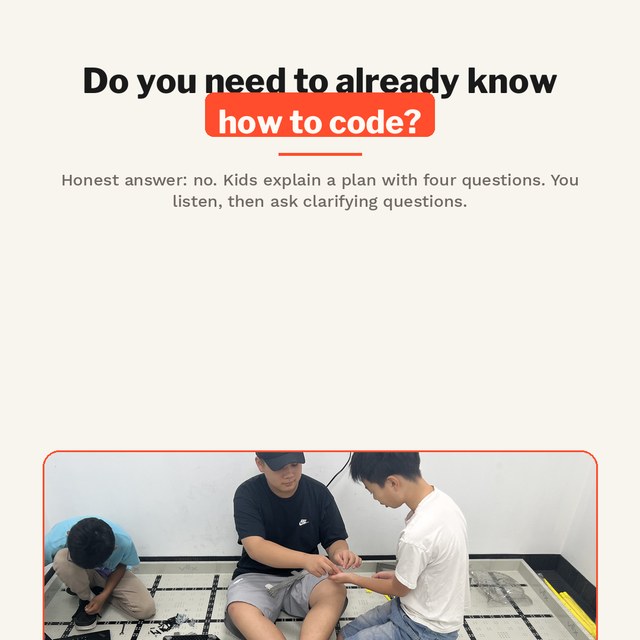
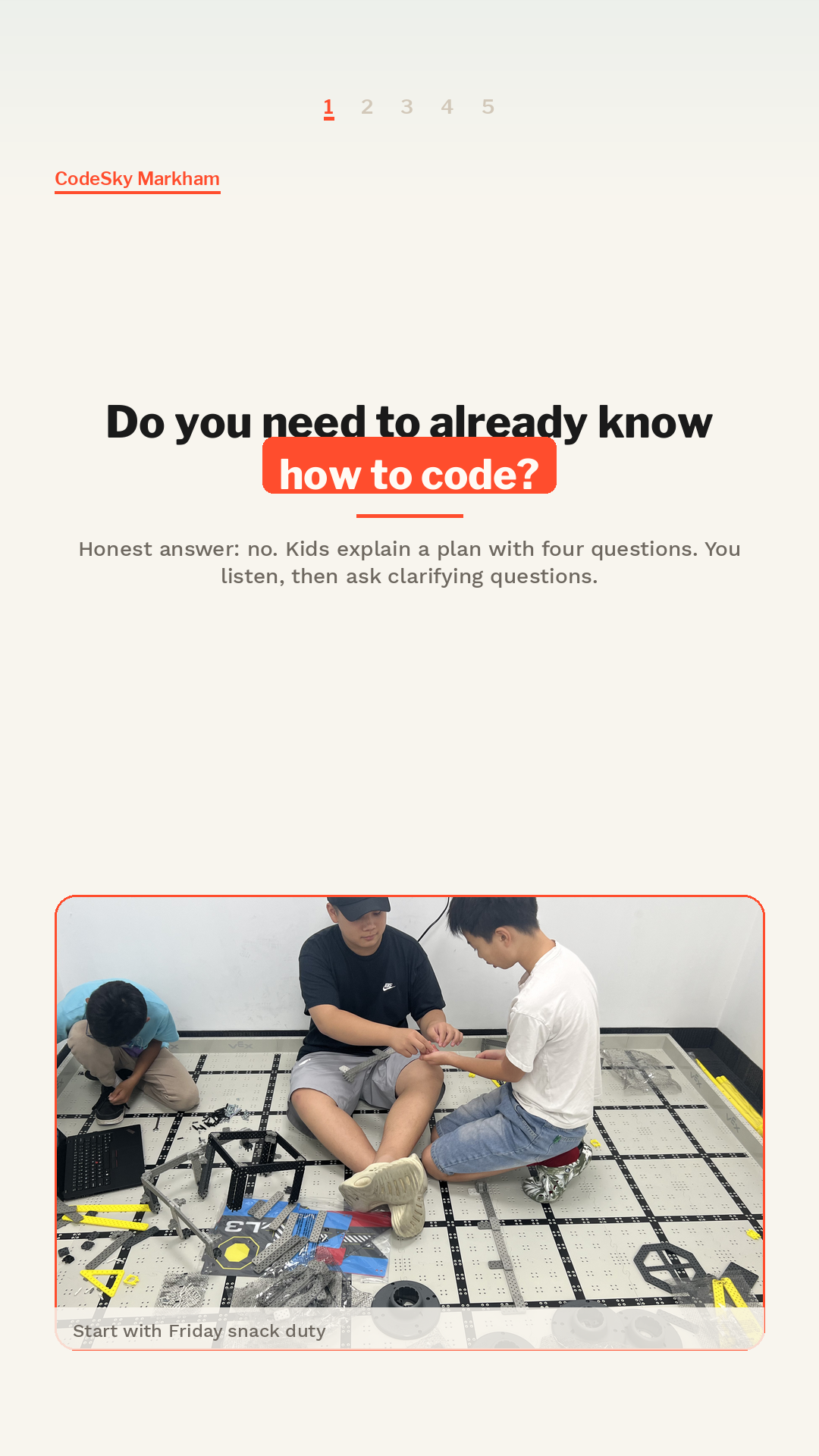
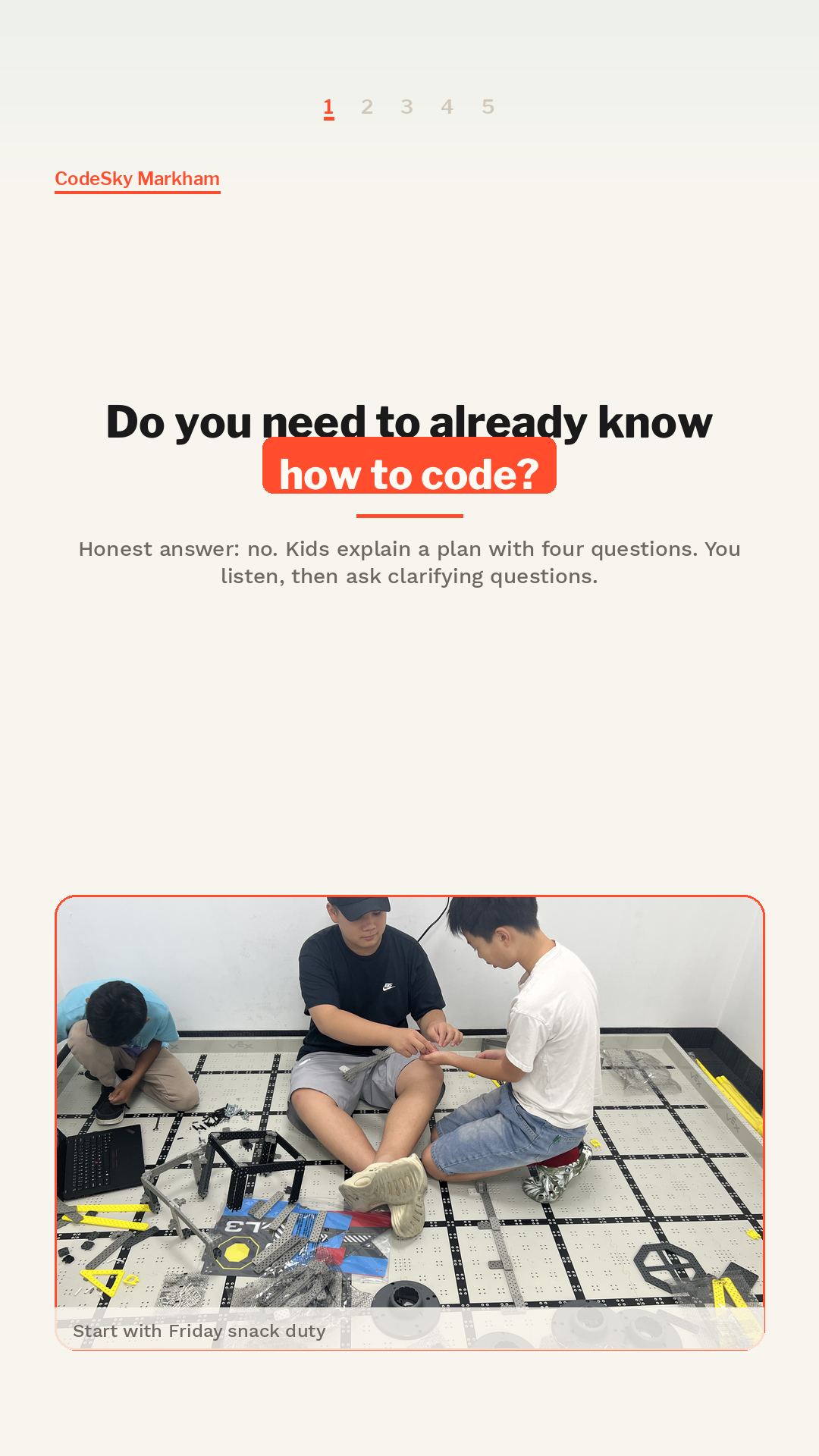
Start with Friday snack duty — English carousel cover for this classroom case
Parents ask it often: does a kid need to already know how to code before they start? In our Markham classroom the honest answer is no. Kids learn to explain a plan with four questions first. Typing comes after.
Why this matters
AI can type code. It cannot replace a kid who can name the goal, hold the right state, and check the edge cases.
A real classroom case: Friday snack rotation
Yesterday we did not open a laptop first. We sorted Friday snack duty for the afterschool table. Who brings snacks this week, what they bring, and which table it lands on. On paper that sounds simple. Then someone forgets, two kids share the same week, a holiday Friday is cancelled, or a new kid joins mid-month. The list stops being a plan and starts being a guess.
|
Goal who · what · which table |
State rotation · allergies · no-bring |
Done list written · confirmed · scheduled |
Edges forgot · double week · holiday · new kid |
Once those four answers are clear, the kid has a sketch that can become code. The typing is the fast part. Our 2026-09-20 Xiaohongshu note used this exact classroom beat: clear thinking first, grammar second.
Why this still matters when AI can write code
Claims below are grounded in that teaching note — not an external product case with published accuracy metrics.
- AI does not remove the need to name the goal. “Who brings this Friday, what they bring, and which table” is a different job from “print a pretty snack menu.” If a kid (or an AI prompt) muddles those, the code that comes back solves the wrong problem.
- The useful state is tiny on purpose. You only hold this month's rotation, allergies, and what not to bring. That is abstraction: keep what the next step needs, drop the rest.
- The done rule and edge cases are the algorithm. The same four questions transfer to a who-leaves-first checklist, a fridge sticky shopping list, or class duty reminders. Contest-style questions inspired by CCC Junior, CCC, BCC, and school contests reuse those moves — kids who want to sit those register on their own; CodeSky is not an official contest program and is not affiliated with Waterloo or CEMC.
- Languages are tools on a path, not the answer. Early work often uses Python so the steps stay readable; JavaScript when the same idea becomes something clickable on a screen; C++ later when speed and structure matter. Tools change; the four questions do not.
So AI’s ability to type code does not cancel a thinking-first start. It raises the value of kids who can name the goal, hold the right state, and check the edge cases before they ask a model to type.
Three steps kids can name
We practice the same shape on the bench:
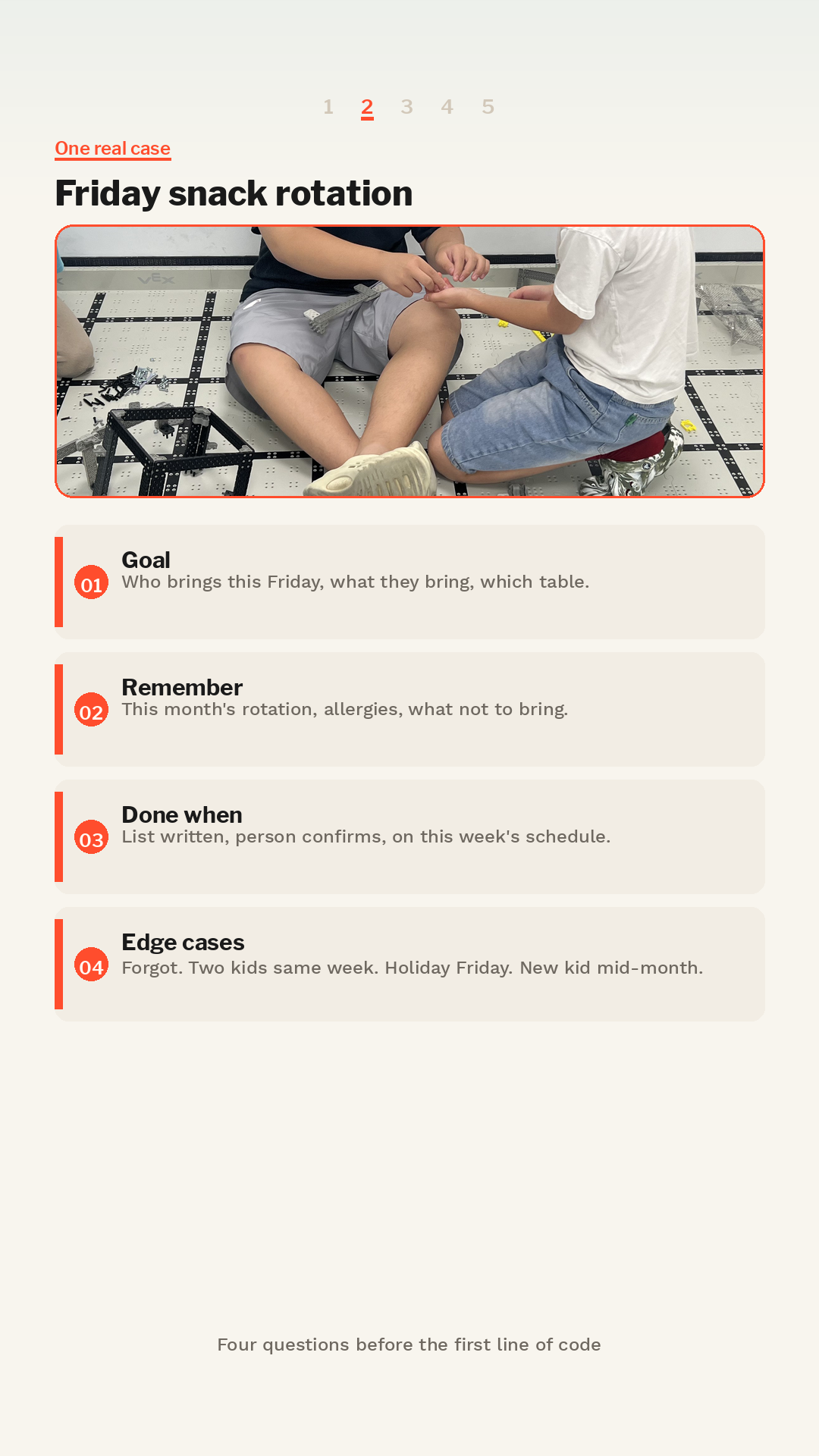
1 · See — the messy Friday snack table
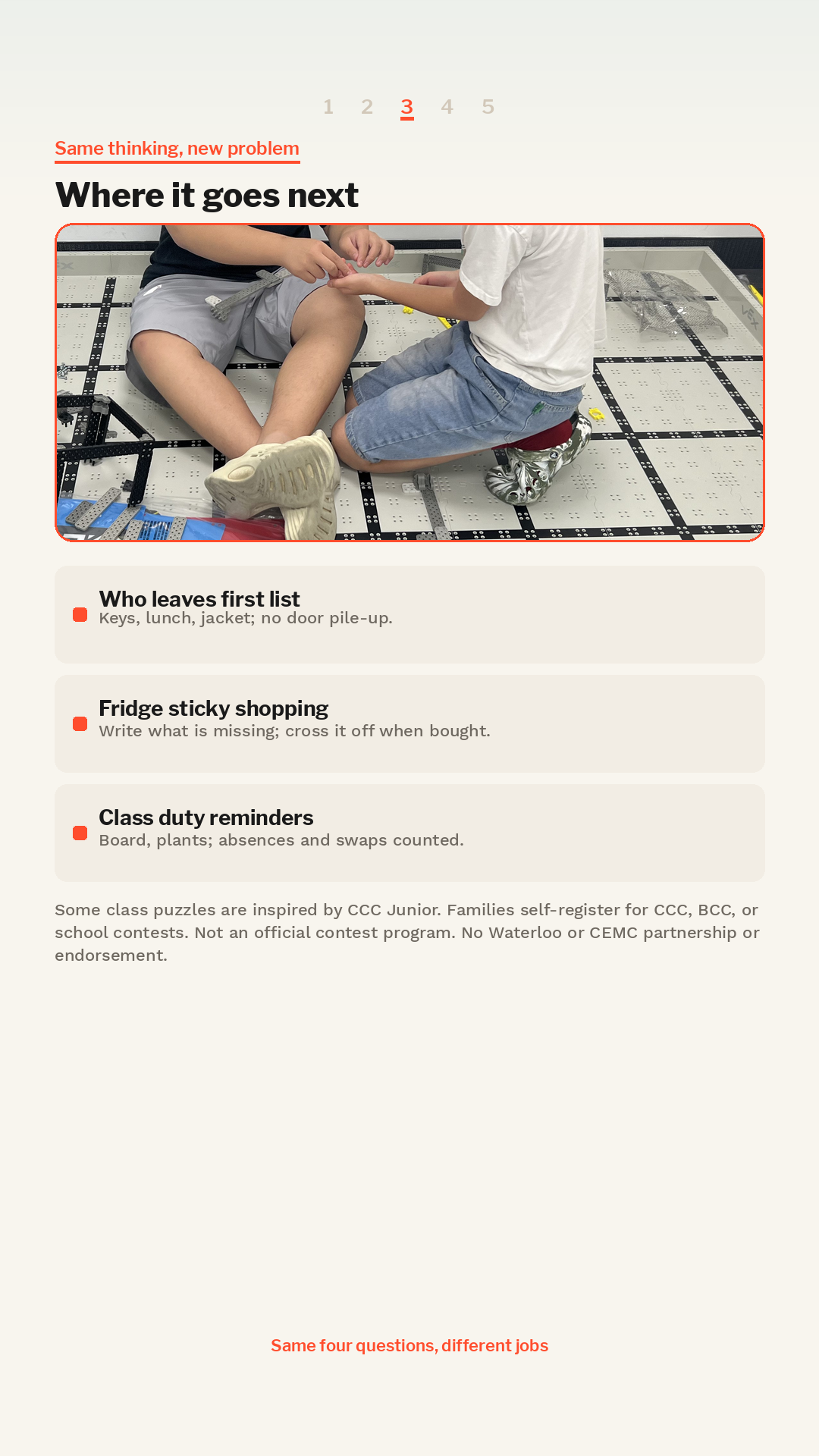
2 · Judge — apply the four rules and edge cases
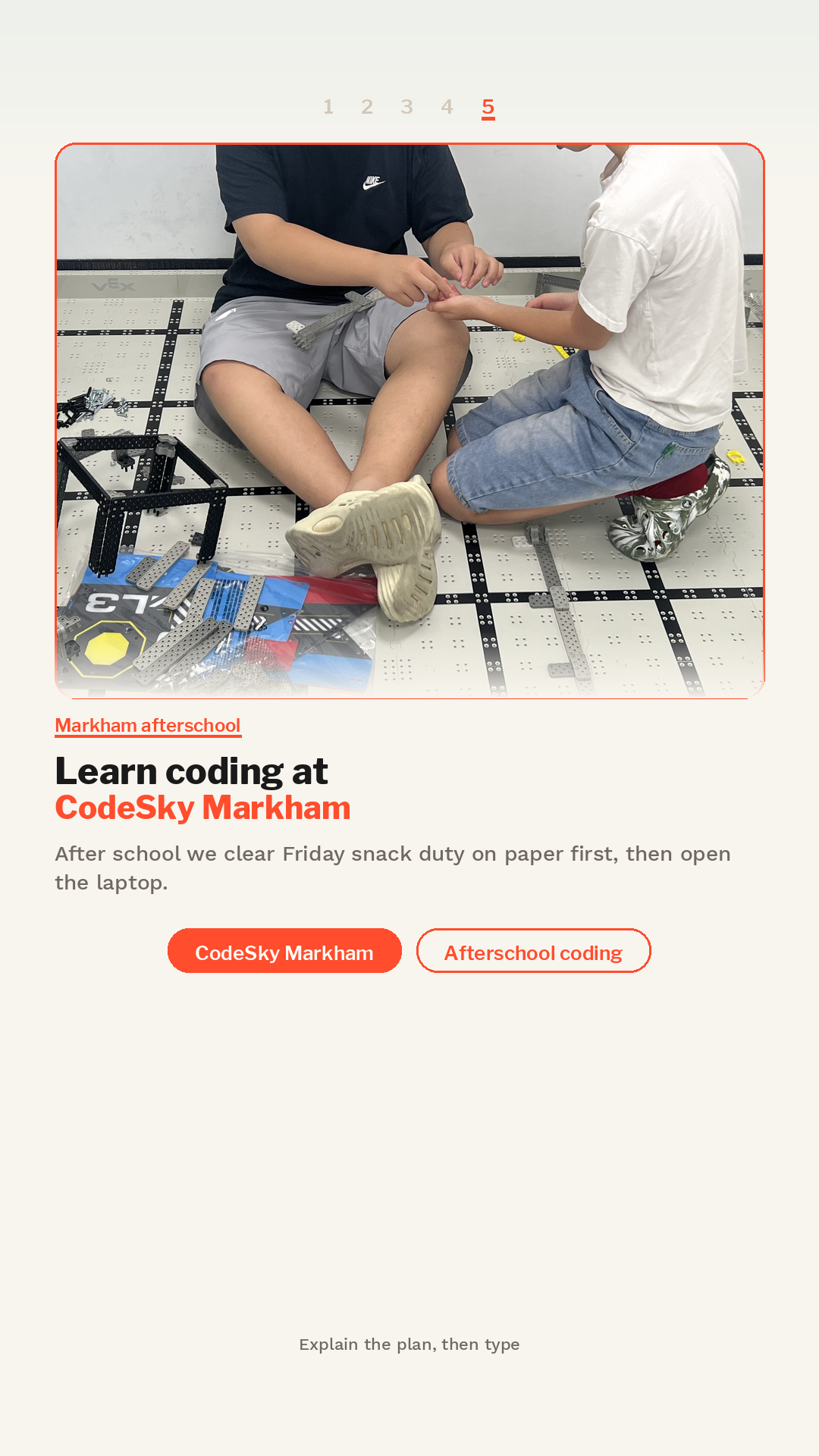
3 · Mission — finish the clear rotation plan
see the messy Friday snack table → judge with the four rules and edge cases → finish the clear rotation plan
Computational thinking kids can own — before AI types a line.
- Decomposition — goal → state → done rule → special cases
- Abstraction — keep only rotation, allergies, and what not to bring
- Algorithms — assign → remember → confirm on schedule → handle forgot / double week / holiday / new kid
- Pattern recognition — same four questions in leave-first lists, fridge sticky shopping, class duty, contest-style I/O
Try this at CodeSky Markham
Walk-in coding afterschool for ages 7–18. Think first, then build — that is what we practice on the bench.
9833 Markham Rd Unit 2, Markham, ON L6E 0E5
Email info@codesky.ca · Comment TRIAL on Instagram @codeskyca
Follow CodeSky
Instagram @codeskyca · 小红书 / RedNote · WeChat 公众号: search codeskyca
Sources: CodeSky Xiaohongshu note pack 2026-09-20-学编程一定要先会代码吗 (Friday snack-bring rotation case; Python → JavaScript → C++ pathway; contest-style disclaimer).