



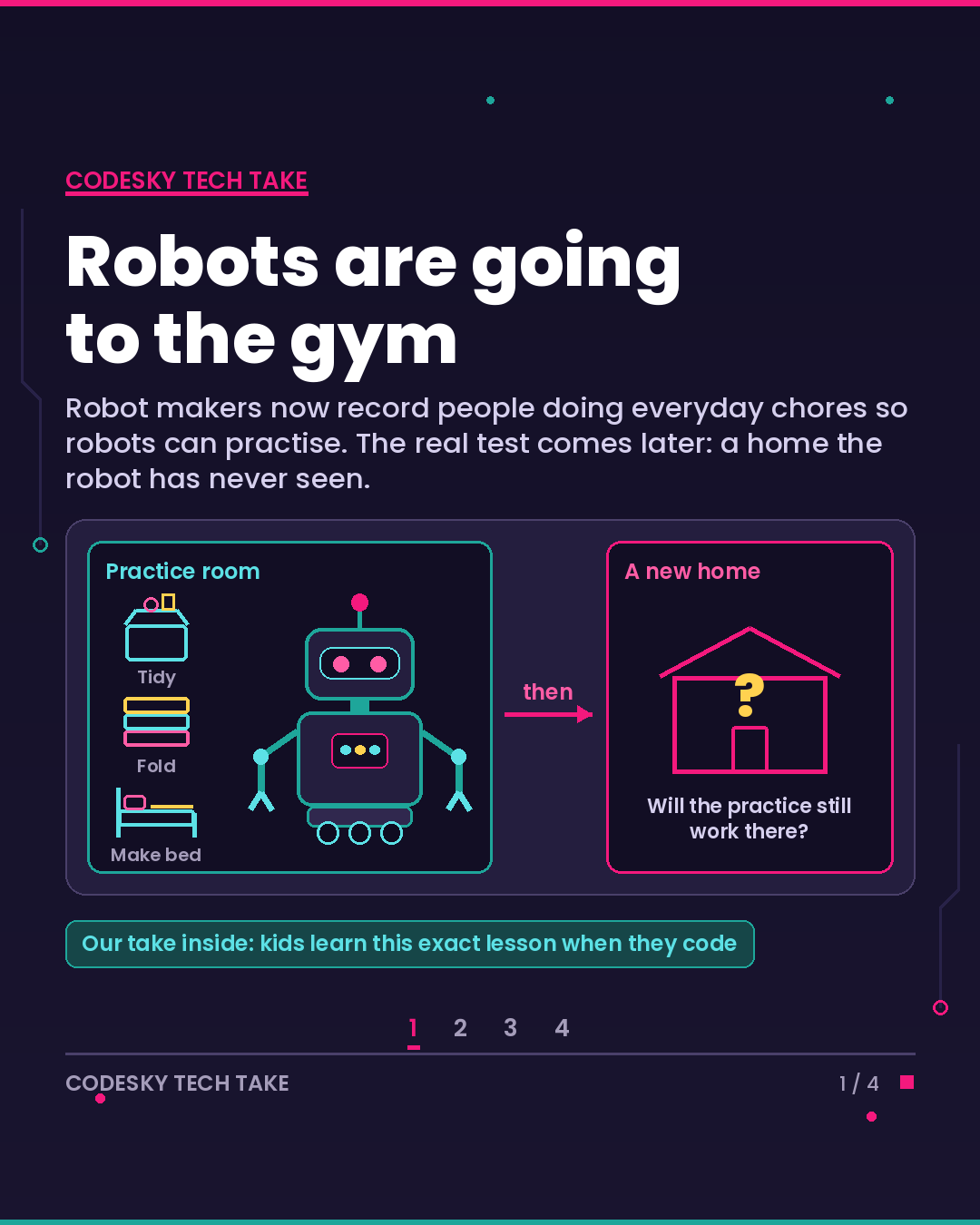
Every young coder says it sooner or later: "But it worked when I tried it!" Then a friend moves the sprite, types an empty answer, or clicks twice, and the program falls over. This week, some of the biggest robot companies in the world ran into the very same lesson, just with towels and unmade beds instead of Scratch sprites.
Why this matters
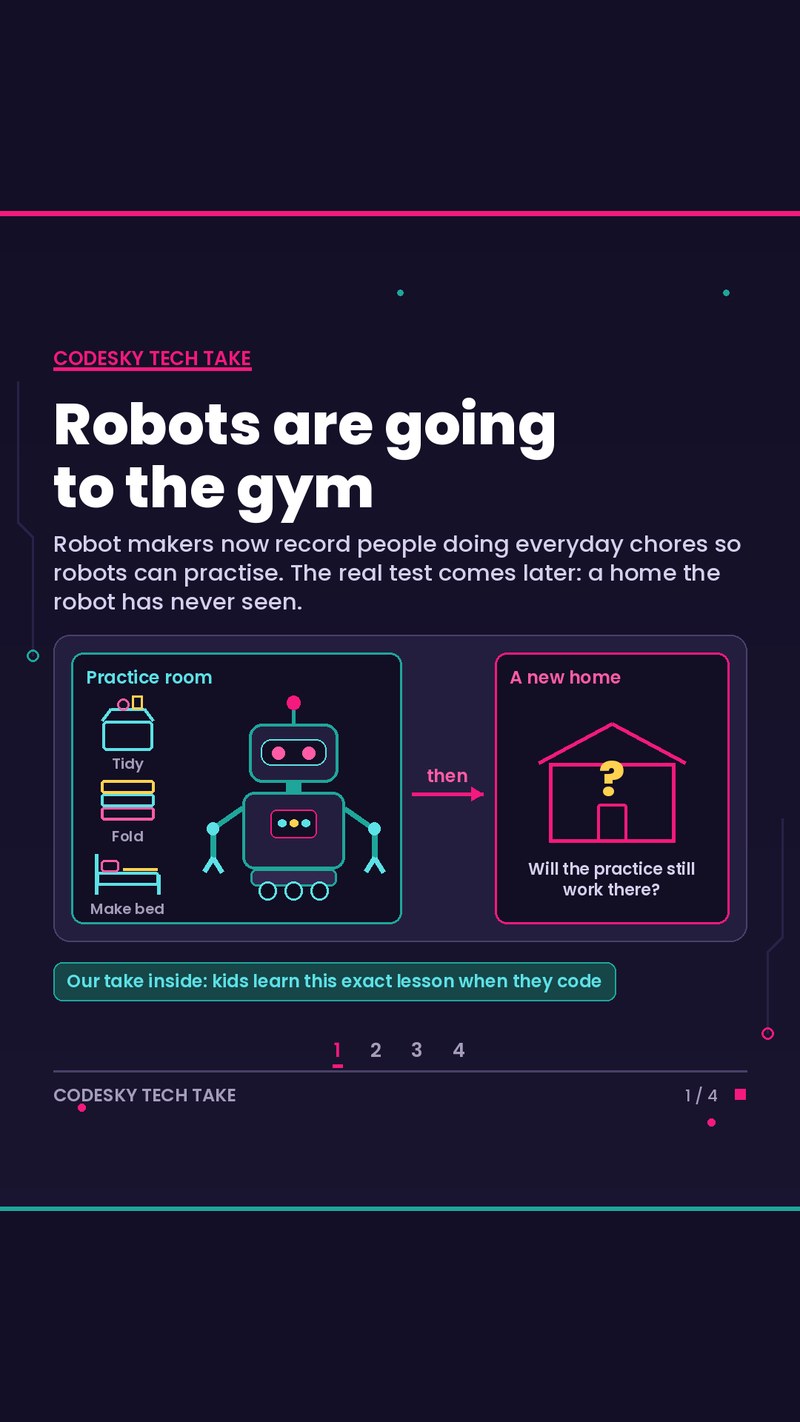
A robot that can fold a towel in the lab is impressive. A robot that can fold a towel in a home it has never seen is useful. The gap between those two is exactly what good programmers learn to test for.
The real story: robots are going to the gym
Robotics companies are now building what they call "robot gyms" and paying people to record everyday tasks, so their AI models have more real examples to learn from.
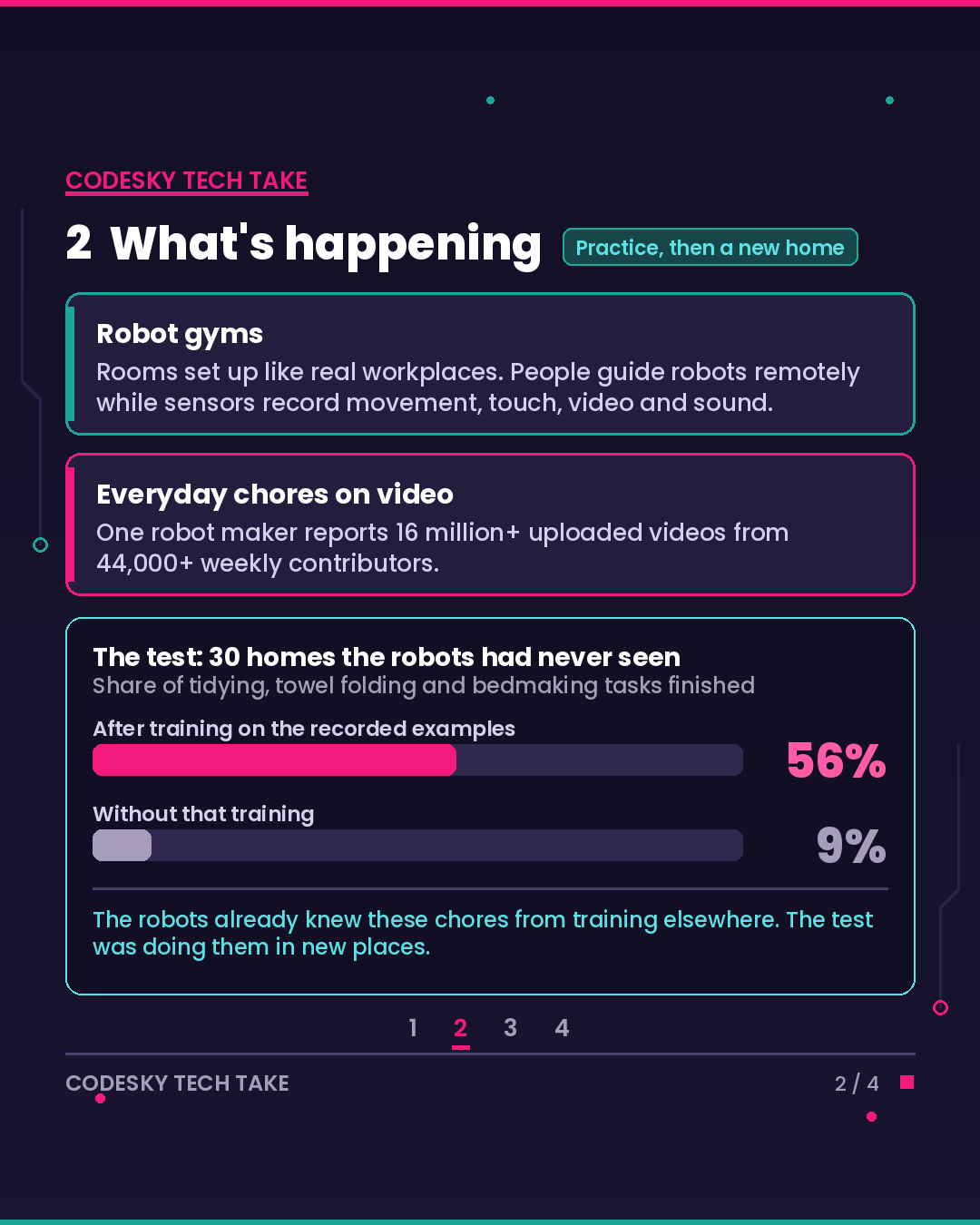
- Gym rooms that copy real workplaces. NEURA Robotics describes gym cells that reproduce a customer's tools, fixtures and working conditions. People guide the robots remotely while the system records movement, force, video, touch and sound.
- Millions of chore videos. Figure says its data program has more than 44,000 weekly contributors and over 16 million uploaded videos of everyday tasks.
- The real exam. Figure reported that its robots finished 56% of tidying, towel folding and bedmaking tasks in 30 Bay Area homes they had never visited, compared with 9% without the earlier training on that video data.
How AI actually helped
It is worth being precise here, because the story is not "AI made robots smart." What the reporting describes is more specific:
- Learning from many examples. The AI model was trained on a huge pile of recorded human demonstrations. The robots had already learned these chores elsewhere, so the test was whether those skills would transfer to new homes and new objects. With the extra training they finished 56% of tasks; without it, 9%.
- Sensors turn practice into data. In the gym cells, sensors capture movement, force, video, touch and sound while a person guides the robot. That recording is what the model learns from.
- Cleaning the data matters. Figure says submissions are filtered, checked for fraud, de-duplicated and labelled before training. More footage only helps if it is good footage.
- Practising the hard parts on purpose. NEURA retrains and tests around difficult grips, lighting conditions and object variations, the situations a robot still struggles with.
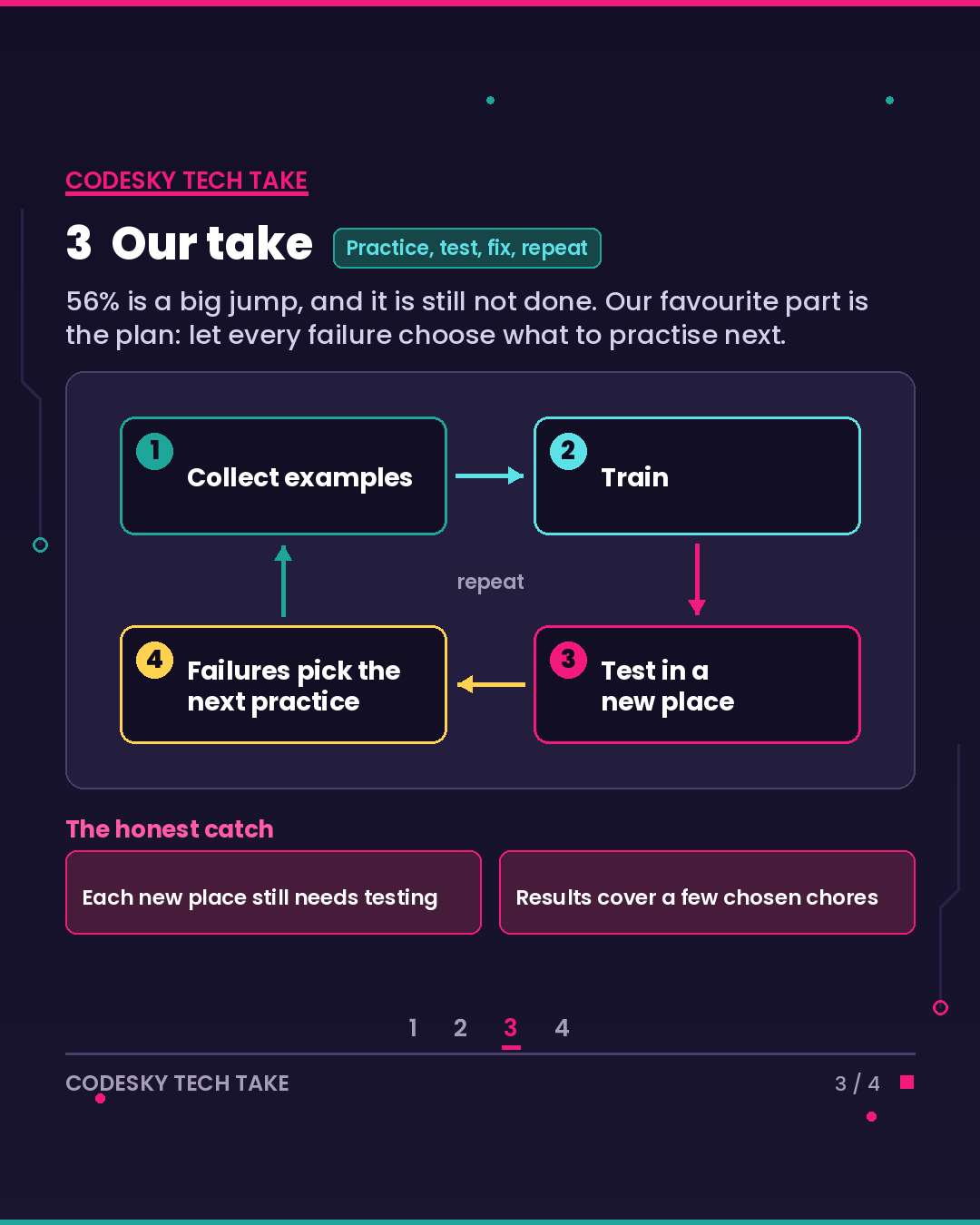
- A loop, not a one-time trick. Physical Intelligence describes a workflow where teams collect demonstrations, train, test on robots, and let failures guide the next round of data collection.
And the honest part: 56% is a big jump, but it is not "done." The tests covered a few selected chores, and each new site may still need preparation and testing before anyone could rely on it.
What kids learn from this
We love this story because the robot engineers' loop is the same thinking skill we coach in class every week. It maps straight onto computational thinking:
- Decomposition: the robot teams split one big goal ("help at home") into small, testable chores: tidy, fold a towel, make a bed. Kids do the same when they break a game into "move," "score," and "game over," and test each part on its own.
- Pattern recognition: a robot needs many examples to spot what stays the same when the room changes. Kids look for the pattern behind their bugs: does it break whenever the sprite starts near the edge, or whenever the input is empty?
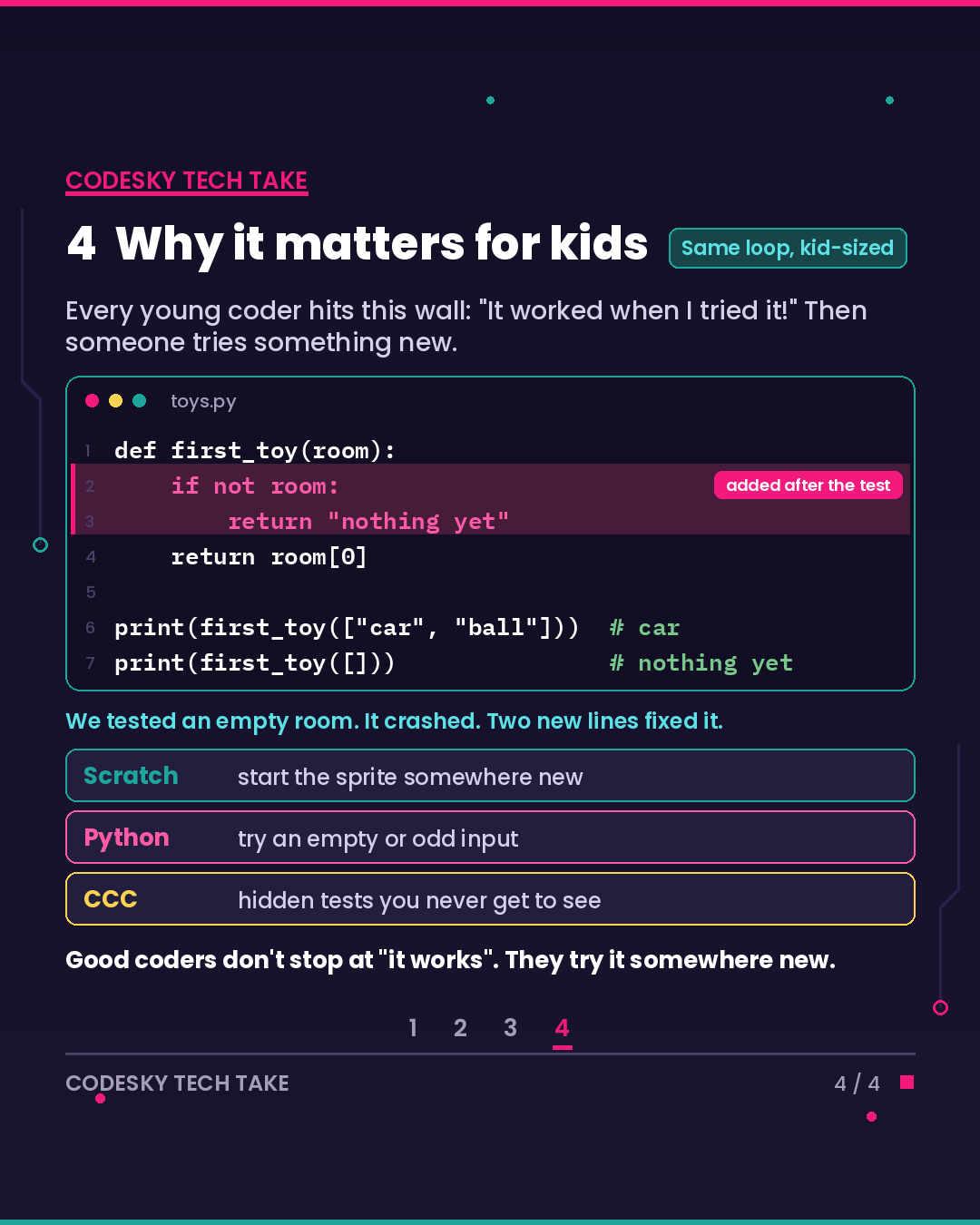
- Abstraction: a good skill works in any home, not just one. A good function works for any list, not just the one you typed in. In our Python lessons, kids write
first_toy(room)and then ask, "What if the room is empty?" - Algorithms and testing: collect, train, test somewhere new, fix what fails, repeat. That is a debugging algorithm, and it is the habit behind the hidden test cases in the CCC (Canadian Computing Competition), where your program is judged on inputs you never get to see.
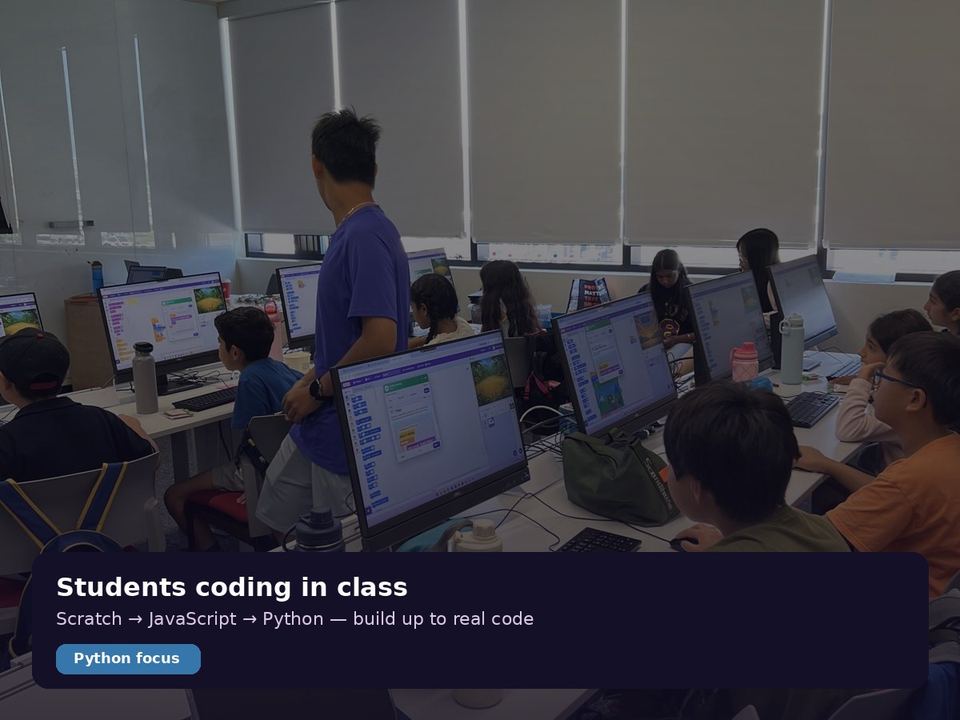
So the path looks like this. In Scratch, kids move the sprite to a new starting spot and run it again. In Python, they try an empty answer or a strange input on purpose. By the time they reach CCC practice, testing beyond "it works for me" feels normal.
Try it at home
Next time your child finishes a game or a project, play the "new home" test: change one thing they didn't expect. Start somewhere new, type nothing, click twice. If it breaks, that is not failure. That is the next thing to practise.
If your child loves building things and figuring out why they break, we would love to meet them. CodeSky runs after-school coding classes in Markham, from Scratch to Python to CCC. Come try a free trial class at 9833 Markham Rd Unit 2, Markham, ON L6E 0E5, or email info@codesky.ca.